
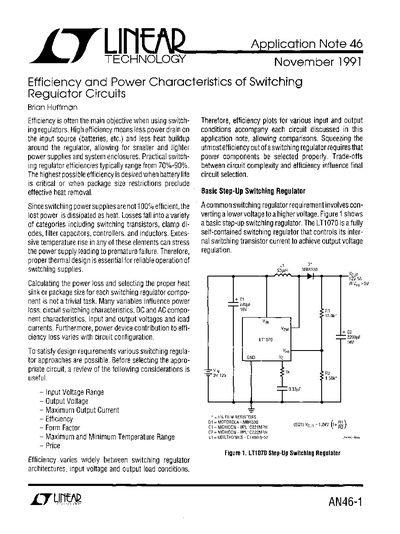
The document explains that high efficiency is a primary objective for switching regulators to reduce power drain and heat buildup. It details how lost power dissipates as heat in components like transistors, diodes, capacitors, controllers, and inductors, emphasizing the need for proper thermal design.
The text reviews various considerations for selecting a circuit, including input voltage range, output voltage, maximum current, efficiency, form factor, temperature range, and price. It provides specific examples of step-up (boost) and step-down switching regulator circuits using the LT1070 and LT1074 chips, respectively.
| Typical Efficiency Range | 70%-90% |
|---|---|
| LT1070 Output Voltage (Example) | > 12V |
| LT1074 Output Current (Example) | 5A |
Practical switching regulator efficiencies typically range from 70% to 90%.
Losses occur in switching transistors, clamp diodes, filter capacitors, controllers, and inductors.
Schottky switching diodes are recommended due to their minimum forward voltage drop and fast recovery time.