
LP2980 is a 50mA micropower low dropout regulator designed by TI. Using the optimized VIP (Vertically Integrated PNP) process, the LP2980 delivers unequaled performance in all key power design specifications.
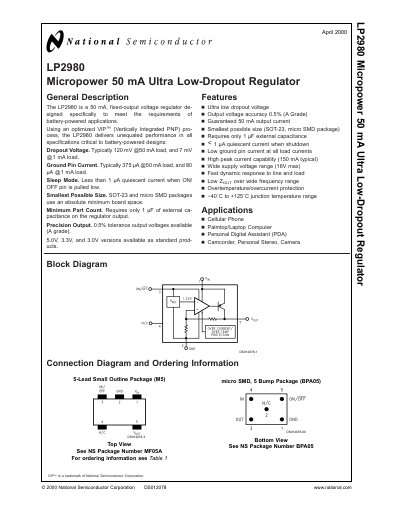
The LP2980 micropower regulator is designed for battery‑powered applications such as cellular phones, PDAs and cameras. It offers a typical dropout of 120 mV at 50 mA, 0.5 % output voltage tolerance, and less than 1 µA quiescent current in shutdown mode.
The device is available in SOT‑23 and micro‑SMD packages, requires only 1 µF of external output capacitance, and supports output currents up to 150 mA peak. It operates from 2.1 V to 16 V input and across a temperature range of –40 °C to +125 °C.
| Dropout Voltage (typical @50 mA) | 120 mV |
|---|---|
| Ground Pin Current (typical @50 mA) | 375 µA |
| Sleep Mode Quiescent Current | <1 µA |
| Output Voltage Tolerance | 0.5 % |
| Required External Output Capacitance | 1 µF |
| Maximum Input Voltage (Operating) | 2.1 V to 16 V |
| Operating Temperature Range | –40 °C to +125 °C |
The typical dropout voltage is 120 mV at a 50 mA load.
Only 1 µF of external output capacitance is required.
It operates from –40 °C up to +125 °C.