
GC5018 is a 8-channel wideband receiver from Texas Instruments, featuring 115 dB SFDR NCO, four 16-bit CMOS ADC input ports, programmable closed loop VGA control, 6-bit outputs, supporting UMTS mode Rx Filtering, CDMA mode Rx Filtering, etc.
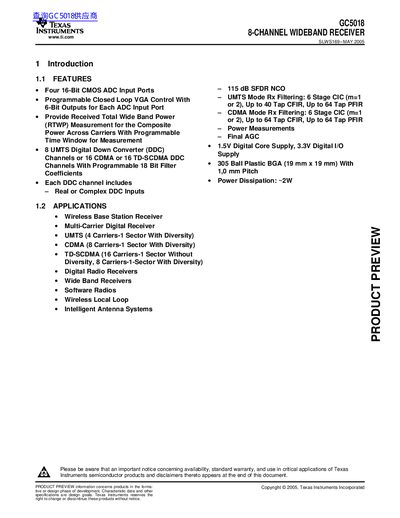
This handbook provides an overview of the Texas Instruments GC5018 8‑channel wideband receiver, describing its architecture, key features, and intended applications such as wireless base stations and software radios. It includes sections on general description, digital signal processing, control interfaces, and programming details.
The document also contains technical specifications, pin descriptions, packaging information, and important legal notices, making it a comprehensive reference for designers and engineers working with the GC5018 device.
| ADC Input Ports | Four 16‑Bit CMOS |
|---|---|
| UMTS Digital Down Converter (DDC) Channels | 8 |
| Spurious-Free Dynamic Range (SFDR) | 115 dB |
| Power Dissipation | ~2W |
| Digital Core Supply Voltage | 1.5V |
| Digital Supply Voltage | 3.3V |
The device dissipates approximately 2 W.
It supports eight UMTS digital down‑converter channels.
The spurious‑free dynamic range is 115 dB.
The receiver has four 16‑bit CMOS ADC input ports.