
This document describes the features and characteristics of the STM1001 reset circuit, including precision monitoring of 3V, 3.3V, and 5V supply voltages, open drain RST output, minimum 140ms reset pulse width, low supply current, etc.
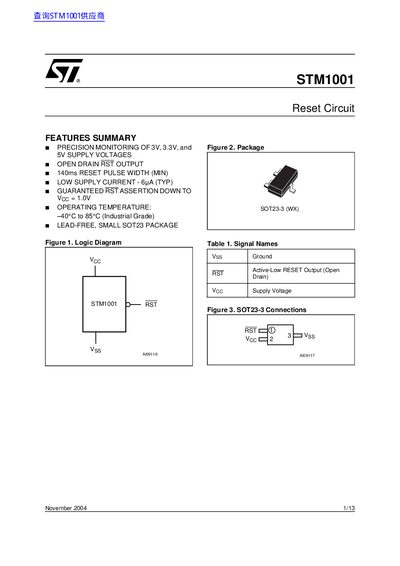
The STM1001 Reset Circuit is a low‑power supervisory device that asserts a reset signal whenever the supply voltage (VCC) drops below a preset threshold and holds it until the voltage rises above the threshold for a minimum reset time‑out period. The reset output is open‑drain and remains valid down to VCC = 1.0 V.
Key features include precision monitoring of 3 V, 3.3 V and 5 V supplies, a minimum 140 ms reset pulse width, typical supply current of 6 µA, and operation over an industrial temperature range of –40 °C to 85 °C. The device is offered in a lead‑free SOT23‑3 package with various VRST threshold options (L, M, T, S, R).
| Supply Voltage (VCC) | 1.0 V to 5.5 V |
|---|---|
| Operating Temperature | –40 °C to 85 °C |
| Reset Pulse Width (minimum) | 140 ms |
| Supply Current (typical) | 6 µA |
The minimum reset pulse width is 140 ms.
It operates from 1.0 V up to 5.5 V.
The reset output is guaranteed valid down to VCC = 1.0 V.
Typical supply current is 6 µA.