
The SN74ALVCH168663 is an 18-bit bus transceiver designed for 1.65-V to 3.6-V VCC operation. It is characterized by ESD protection, bus hold on data inputs, and low power consumption.
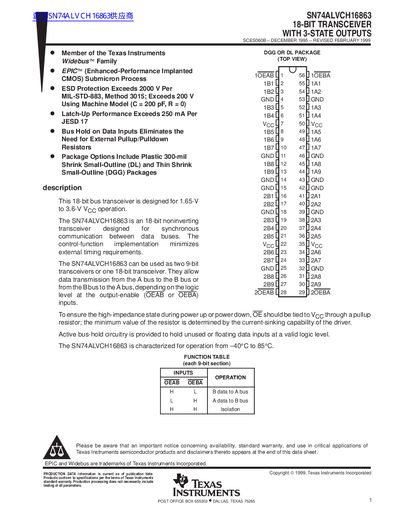
The SN74ALVCH16863 is an 18‑bit non‑inverting bus transceiver designed for synchronous communication between data buses. It can operate as two 9‑bit transceivers or a single 18‑bit transceiver, with control inputs that select the direction of data flow.
Key features include bus‑hold on data inputs, ESD protection exceeding 2000 V, latch‑up current up to 250 mA, and operation over a supply range of 1.65 V to 3.6 V. The device is specified for temperatures from –40 °C to 85 °C and is offered in DL and DGG plastic packages.
| Supply voltage range | 1.65 V – 3.6 V |
|---|---|
| Operating temperature range | -40 °C to 85 °C |
| Bus‑hold feature | Eliminates need for external pull‑up/pull‑down resistors |
| Package options | Plastic 300‑mil Shrink Small‑Outline (DL) and Thin Shrink Small‑Outline (DGG) |
The device operates with a supply voltage between 1.65 V and 3.6 V.
It is specified for operation from –40 °C to 85 °C.
It is offered in Plastic 300‑mil Shrink Small‑Outline (DL) and Thin Shrink Small‑Outline (DGG) packages.