
This document provides information on the approved crystal manufacturers by Micrel Semiconductor and their testing requirements. It also includes the common crystal frequencies used with Micrel receivers and the corresponding formulas.
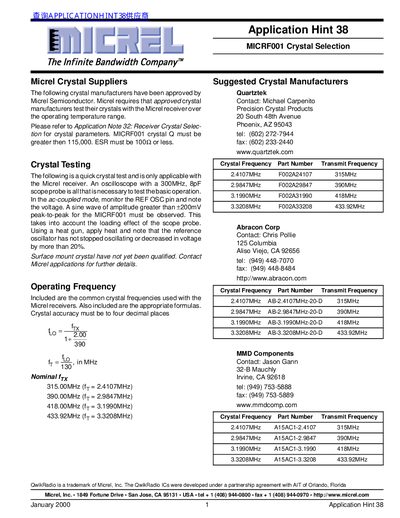
This application note provides guidance for selecting crystals to be used with Micrel's MICRF001 receiver. It lists approved crystal manufacturers, required crystal parameters, and a quick test procedure using a standard oscilloscope.
The document also includes a table of common crystal frequencies and corresponding part numbers from several suppliers, as well as operating frequency formulas and nominal frequency values for the receiver.
| Minimum crystal Q factor | >115,000 |
|---|---|
| Maximum crystal ESR | ≤ 1009 Ω |
| Nominal operating frequencies | 315 MHz, 390 MHz, 418 MHz, 433.92 MHz |
The crystal Q must be greater than 115,000.
The ESR must be 1009 Ω or less.
Common frequencies are 315 MHz, 390 MHz, 418 MHz, and 433.92 MHz.
Use a 300 MHz, 8 pF oscilloscope probe to monitor the REF OSC pin; a sine wave > +200 mV p‑p indicates proper operation.