
This document describes the features and characteristics of the RPI-303 Photointerrupter, including its tall package, small package size due to double-layer mold, and heat resistance with PPS package. It also mentions its application as a reel count sensor for VCR DVD.
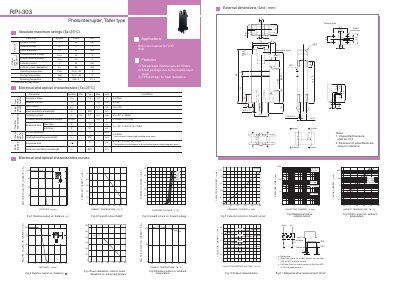
The RPI-303 is a tall‑type photointerrupter with an optical axis of 20.75 mm, designed for reel‑count sensing in VCR and DVD applications. It features a compact double‑layer mold, PPS package for heat resistance, and a small overall footprint.
The document lists absolute maximum ratings, electrical and optical characteristics, mechanical dimensions, and typical application circuits. It also includes notes on export control and usage restrictions for safety‑critical equipment.
| Forward current (If) | 50 mA |
|---|---|
| Reverse voltage (Vr) | 5 V |
| Power dissipation (Po) | 80 mW |
| Collector‑emitter voltage (Vceo) | 30 V |
| Emitter‑collector voltage (Veco) | 45 V |
| Collector current (Ic) | 30 mA |
| Operating temperature range | -25 °C to +85 °C |
| Peak sensitivity wavelength | 800 nm |
| Rise time (tr) | 10 ps |
| Cut‑off frequency | 1 MHz |
The maximum forward current is 50 mA.
The device is rated for a reverse voltage of 5 V.
It operates from –25 °C to +85 °C.
The peak sensitivity wavelength is 800 nm.