
NCP3065 is a high-brightness LED constant current driver with 235mV low feedback voltage, wide input voltage range, and can be configured as step-down and step-up switching power supplies
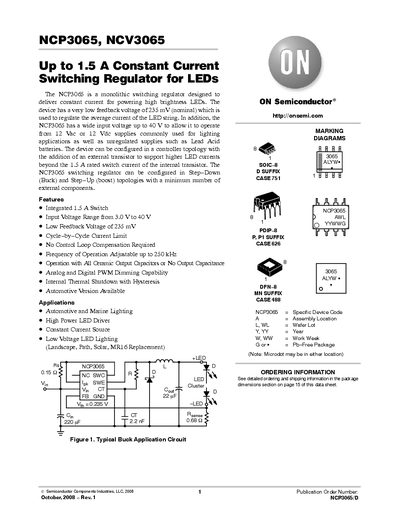
The NCP3065 and NCV3065 are monolithic switching regulators designed to deliver constant current for high‑brightness LED applications. They operate from a wide input voltage range and can be configured in buck or boost topologies with minimal external components.
Key features include an integrated 1.5 A switch, low feedback voltage of 235 mV, adjustable oscillator frequency up to 250 kHz, and built‑in thermal shutdown. The device supports analog and digital PWM dimming, and can operate without an output capacitor in continuous‑conduction mode.
| Input Voltage Range | 3.0 V to 40 V |
|---|---|
| Integrated Switch Current | 1.5 A |
| Low Feedback Voltage | 235 mV |
| Oscillator Frequency Range | 100 kHz to 300 kHz |
| Maximum Switch Current (Darlington) | 15 A |
| Thermal Shutdown Threshold | 165 °C |
| Thermal Resistance Junction‑to‑Air (SOIC‑8) | 180 °C·W⁻¹ |
The switching frequency of the NCP3065 is typically between 100 kHz and 300 kHz.
Thermal shutdown activates at approximately 165 °C to protect the device.
The device can operate with an input voltage up to 40 V.