
The HIP6601B, HIP6603B and HIP6604B are high-frequency, dual MOSFET drivers specifically designed to drive two power N-Channel MOSFETs in a synchronous rectified buck converter topology. These drivers combined with a HIP63xx or the ISL65xx series of Multi-Phase Buck PWM controllers and MOSFETs form a complete core-voltage regulator solution for advanced microprocessors. The HIP6601B drives the lower gate in a synchronous rectifier to 12V, while the upper gate can be independently driven over a range from 5V to 12V. The HIP6603B drives both upper and lower gates over a range of 5V to 12V. This drive-voltage flexibility provides the advantage of optimizing applications involving trade-offs between switching losses and conduction losses. The HIP6604B can be configured as either a HIP6601B or a HIP6603B. The output drivers in the HIP6601B, HIP6603B and HIP6604B have the capacity to efficiently switch power MOSFETs at frequencies up to 2MHz. Each driver is capable of driving a 3000pF load with a 30ns propagation delay and 50ns transition time. These drivers have extremely low EMI and have been qualified to AEC-Q100.
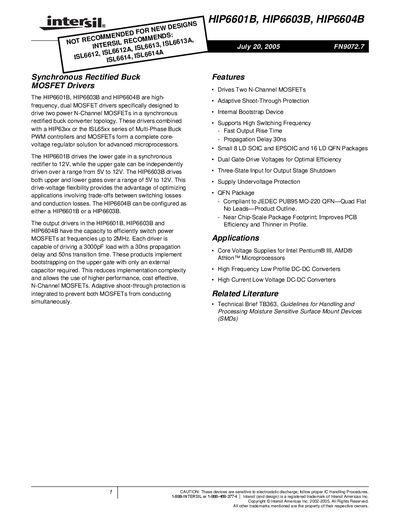
The HIP6601B, HIP6603B and HIP6604B are high‑frequency dual MOSFET drivers designed for synchronous‑rectified buck converters. They can drive two N‑Channel power MOSFETs and support flexible gate‑drive voltages ranging from 5 V to 12 V.
Key features include adaptive shoot‑through protection, internal bootstrap, fast output rise time (30 ns propagation delay, 50 ns transition), and operation up to 2 MHz. The devices are offered in 8‑lead SOIC, 8‑lead EPSOIC and 16‑lead QFN packages and meet JEDEC QFN specifications.
| Propagation Delay | 30 ns |
|---|---|
| Transition Time | 50 ns |
| Maximum Switching Frequency | 2 MHz |
| Available Packages | 8‑lead SOIC, 8‑lead EPSOIC, 16‑lead QFN |
| Maximum Junction Temperature (Plastic Package) | 150 °C |
| Input Voltage Range (Vpyy) | 0.3 V to 7 V |
The drivers can operate at frequencies up to 2 MHz.
The propagation delay is specified as 30 ns.
They are available in 8‑lead SOIC, 8‑lead EPSOIC, and 16‑lead QFN packages.