
BT137X series D logic level triacs product specification, glass passivated, sensitive gate triacs, intended for use in general purpose bidirectional switching and phase control applications.
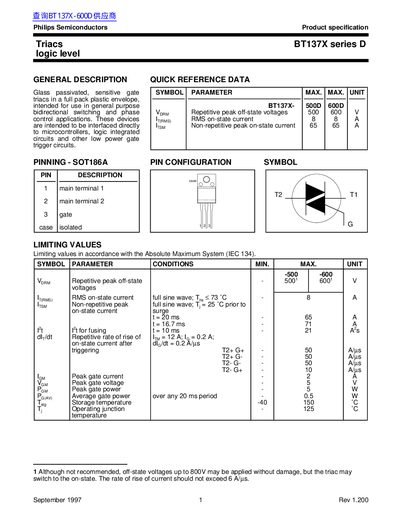
The Philips BT137X series D logic level triacs are glass‑passivated devices in a full‑pack plastic envelope, intended for general‑purpose bidirectional switching and phase‑control applications. They can be driven directly from microcontrollers or low‑power gate‑trigger circuits.
The datasheet provides detailed electrical limits, thermal characteristics, pin configuration, mechanical dimensions and definitions of the specification status. It also includes safety notices for life‑support applications.
| Repetitive peak off‑state voltage (V_RRM) | 500‑600 V |
|---|---|
| RMS on‑state current (I_T(RMS)) | 8 A |
| Storage temperature range | -40 °C to 150 °C |
| Maximum junction temperature (Tj) | 125 °C |
The device can withstand a repetitive peak off‑state voltage of 500 V to 600 V.
It is rated for a continuous RMS on‑state current of 8 A.
The triac can be stored between –40 °C and 150 °C.
The maximum junction temperature is 125 °C.