
The BT138B series is a glass passivated triac produced by Philips Semiconductors. It is suitable for surface mounting and is intended for use in applications requiring high bidirectional transient and blocking voltage capability and high thermal cycling performance. Typical applications include motor control, industrial and domestic lighting, heating and static switching.
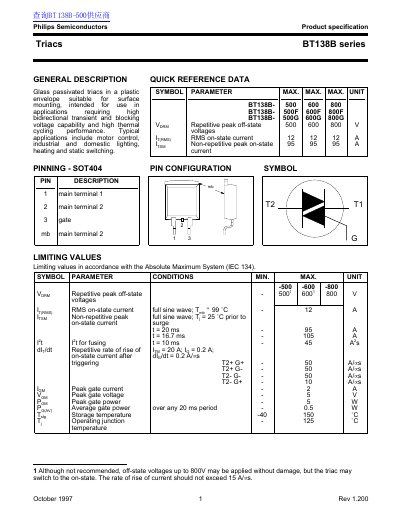
This datasheet describes the BT138B series triacs, covering general description, pin configuration, limiting values and detailed electrical characteristics such as on‑state current, off‑state voltage and gate trigger parameters. It also includes thermal resistance data, mechanical dimensions and mounting instructions.
The document is intended for designers of motor control, lighting, heating and static‑switching applications, offering reference tables, graphs and limits in accordance with IEC 134 standards. This manual is written in Chinese.
| Repetitive peak off‑state voltage (VDRM) | 500‑800 V |
|---|---|
| RMS on‑state current (IT(RMS)) | 12 A |
| Thermal resistance junction‑to‑mounting base (Rth j‑mb) | 1.5 K/W typical |
| Storage temperature range | -40 °C to 150 °C |
The BT138B series can withstand up to 800 V in the off‑state.
Store the device between –40 °C and +150 °C.
The typical RMS on‑state current rating is 12 A.
Typical thermal resistance (junction‑to‑mounting base) is 1.5 K/W.