
The AD1893 SamplePort is a fully digital, stereo Asynchronous Sample Rate Converter (ASRC) that solves sample rate interfacing and compatibility problems. It features low cost, low power consumption, automatic sensing of sample frequencies, rejection of sample clock jitter, accommodation of dynamically changing asynchronous sample clocks, a wide range of sample clock frequencies, and performance with 96 dB THD+N.
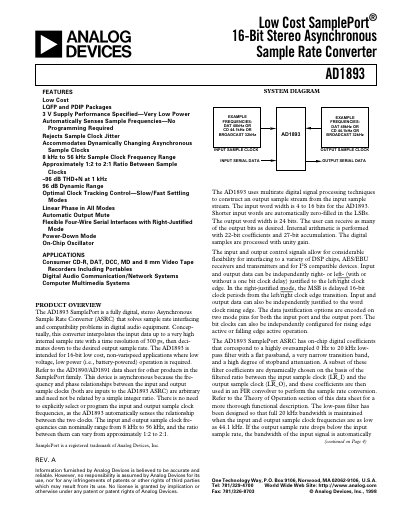
The AD1893 SamplePort is a fully digital, stereo asynchronous sample‑rate converter designed for low‑cost, low‑power audio applications. It automatically senses input and output sample frequencies, rejects jitter, and supports dynamic clock tracking with slow‑ and fast‑settling modes.
The document provides detailed specifications, pin configurations, digital timing parameters, power consumption data, and theory of operation for designers and engineers.
| Dynamic Range | 96 dB |
|---|---|
| THD+N (1 kHz Full‑Scale Input) | -94 dB |
| Supply Voltage (Test Condition) | +3.0 V |
| Package Options | AD1893JN Plastic DIP N‑28, AD1893JST LQFP ST‑44 |
| Typical Operating Current (VDD = +5.0 V) | 40 mA |
| Typical Power‑Down Current (VDD = +5.0 V) | 2.5 mA |
| Sample Clock Frequency Range | 8 kHz to 56 kHz |
The input and output sample clock frequencies can nominally range from 8 kHz to 56 kHz.