
The ADA4304-3/ADA4304-4 is a 1:3 and 1:4 single-ended, low cost, active RF splitter.
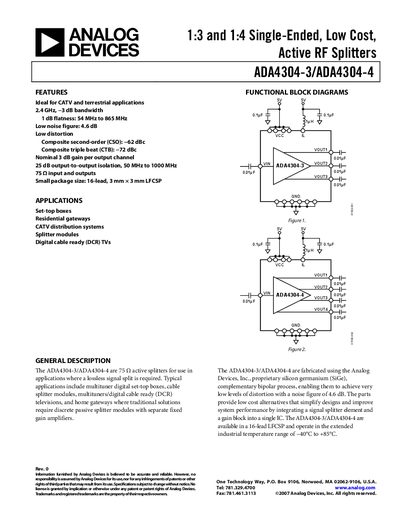
The ADA4304-3 and ADA4304-4 are 75 Ω active RF splitters designed for lossless signal distribution in CATV, set‑top boxes, residential gateways and other broadband applications. They integrate a splitter element and a gain block in a single 16‑lead LFCSP package.
The document lists detailed electrical specifications such as bandwidth, gain, noise figure and isolation, as well as absolute maximum ratings, thermal resistance, pin functions, and ordering information. Performance graphs and typical characteristics are included to aid designers in evaluating the parts for their systems.
| Bandwidth (‑3 dB) | 2400 MHz |
|---|---|
| Frequency Range | 54 – 865 MHz |
| Gain at 100 MHz | 3.3 dB (typical) |
| Noise Figure @ 54 MHz | 4.0 dB |
| Nominal Supply Voltage | 5.0 – 5.25 V |
| Quiescent Supply Current | 92 – 105 mA |
| Operating Temperature Range | -40 °C to +85 °C |
| Package | 16‑lead LFCSP, 3 mm × 3 mm |
| Maximum Power Dissipation | 551 mW |
The typical gain is 3.3 dB at 100 MHz.
It operates from –40 °C to +85 °C.
The nominal supply voltage is 5.0 V to 5.25 V.