
This document describes the features and characteristics of the BZT52-V series small signal zener diodes. These diodes are silicon planar power zener diodes. The document also mentions other case styles and configurations available, including the SOT-23 case with type designation BZX84 series, the dual zener diode common anode configuration in the SOT-23 case with type designation AZ23 series, and the dual zener diode common cathode configuration in the SOT-23 case with type designation DZ23 series. The zener voltages are graded according to the international E24 standard. The component is lead (Pb)-free and compliant with RoHS 2002/95/EC and WEEE 2002/96/EC standards.
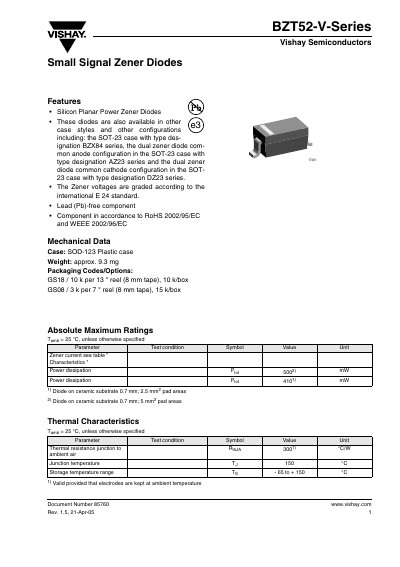
The BZT52‑V series from Vishay are silicon planar power Zener diodes offered in SOD‑123 plastic packages. The series covers a wide range of Zener voltages and complies with RoHS and lead‑free requirements.
The document provides detailed electrical parameters such as Zener voltage ranges, dynamic resistance, power dissipation, thermal resistance, and storage temperature limits, as well as mechanical data and package dimensions.
| Case Type | SOD-123 |
|---|---|
| Weight | ≈ 9.3 mg |
| Maximum Power Dissipation | 500 mW |
| Thermal Resistance (junction‑to‑ambient) | 300 °C/W |
| RoHS Compliance | Lead‑free, RoHS 2002/95/EC |
It uses an SOD‑123 plastic case.
Yes, the diodes are lead‑free and meet RoHS 2002/95/EC requirements.
The maximum power dissipation is 500 mW.