
AD5235 is a dual-channel, 1024-position resolution digital potentiometer launched by Analog Devices. Its features are low temperature drift, 2.7V to 5V single supply or ±2.5V dual supply, SPI compatible serial interface, and batteryless storage.
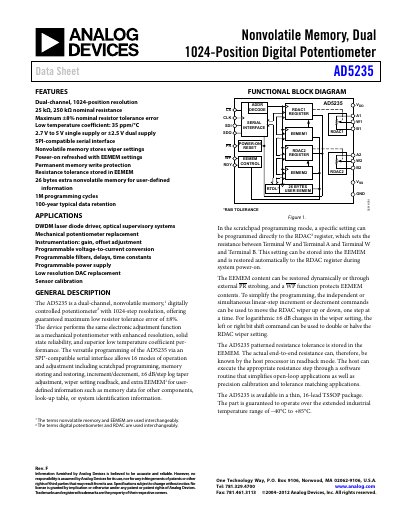
The AD5235 digital potentiometer provides two independent channels with 10‑bit resolution (1024 steps) and non‑volatile memory that retains wiper settings after power‑off. It supports single‑supply operation from 2.7 V to 5 V or dual‑supply ±2.5 V and includes SPI‑compatible serial interface, write‑protect, and EEMEM storage for user data.
The datasheet details electrical characteristics, timing diagrams, absolute maximum ratings, pin functions, and typical performance graphs. It also describes programming modes, advanced control features, and application examples such as gain control, voltage‑to‑current conversion, and optical transmitter calibration.
| Resolution | 10 bits (1024 steps) |
|---|---|
| Nominal Resistance Options | 25 kΩ, 250 kΩ |
| Temperature Coefficient | 35 ppm/°C |
| Single‑Supply Voltage Range | 2.7 V to 5 V |
| Dual‑Supply Voltage Range | ±2.5 V |
| Programming Cycle Endurance | 1 M cycles |
The AD5235 provides 10‑bit resolution, giving 1024 discrete steps.
The device is rated for up to one million programming cycles.