
1024-position nonvolatile digital potentiometer AD5231 data sheet. The potentiometer has 1024-bit resolution and can save user settings for continued operation after power is turned off.
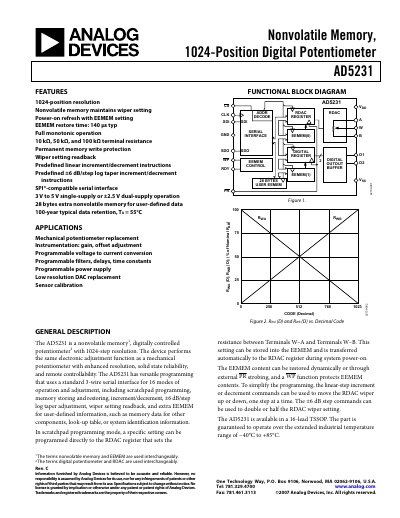
The AD5231 provides a 1024‑step resolution digital potentiometer that retains its wiper setting after power‑off using nonvolatile memory. It supports single‑supply (3 V‑5 V) or dual‑supply operation and offers terminal resistance options of 10 kΩ, 50 kΩ, and 100 kΩ. Features include SPI‑compatible serial control, programmable log‑taper steps, and 28 bytes of extra EEMEM for custom data.
The datasheet details electrical and timing specifications, pin functions, programming modes (scratchpad, EEMEM, increment/decrement), and reliability data such as 100‑year data retention and 100 k‑cycle endurance. Application examples cover mechanical potentiometer replacement, instrumentation gain/offset adjustment, and programmable voltage‑to‑current conversion.
| Resolution | 1024 positions (10‑bit) |
|---|---|
| Supply Voltage | 3 V ± 10 % to 5 V ± 10 % (single‑supply) or ±2.5 V dual‑supply |
| Operating Temperature Range | −40 °C to +85 °C |
| Terminal Resistance Options | 10 kΩ, 50 kΩ, 100 kΩ |
| Data Retention | Typical 100 years at 55 °C |
It uses an SPI‑compatible serial interface for programming and control.
The device provides 1024 discrete positions.
The EEMEM restore time is typically 140 µs.