
The KSR2206 is a PNP type silicon transistor produced by Fairchild Semiconductor Corporation. Its maximum rated collector-base reverse voltage is -50V, collector-emitter voltage is -50V, emitter-base voltage is -10V, and maximum collector current is -100mA. Its maximum collector power dissipation is 300mW and its working temperature range is -55℃~150℃.
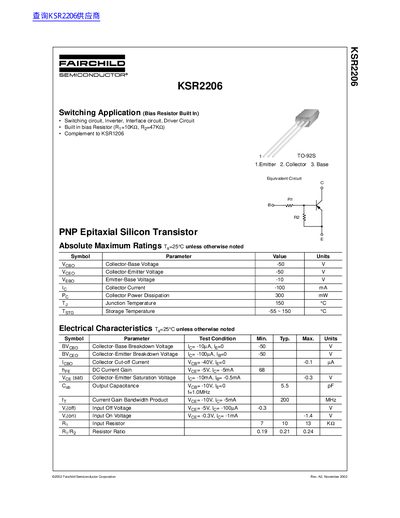
The KSR2206 is a PNP epitaxial silicon transistor designed for switching, inverter, interface, and driver circuits. It includes a built‑in bias resistor network (Ry = 10 kΩ, Re = 47 kΩ) and is offered as a complement to the KSR1206 series.
Key specifications such as maximum voltage ratings, current limits, power dissipation, and thermal limits are listed, along with typical characteristic curves and mechanical dimensions for the TO‑92 (TO‑928) package.
| Collector‑Base Voltage (Vcbo) | -50 V |
|---|---|
| Collector‑Emitter Voltage (Vceo) | -50 V |
| Emitter‑Base Voltage (Vebo) | -10 V |
| Collector Current (Ic) | -100 mA |
| Collector Power Dissipation (P) | 300 mW |
| Junction Temperature (Tj) | 150 °C |
| Storage Temperature | -55 ~ 150 °C |
| Input Resistor (Ry) | 10 kΩ |
| Resistor Ratio (R4/Ag) | 0.19 |
The collector‑emitter breakdown voltage is -50 V.
The device is supplied in a TO‑92 (TO‑928) package.
Yes, it includes a built‑in bias resistor network with Ry = 10 kΩ and Re = 47 kΩ.