
Low power RS-485 / RS-422 differential bus transceiver.
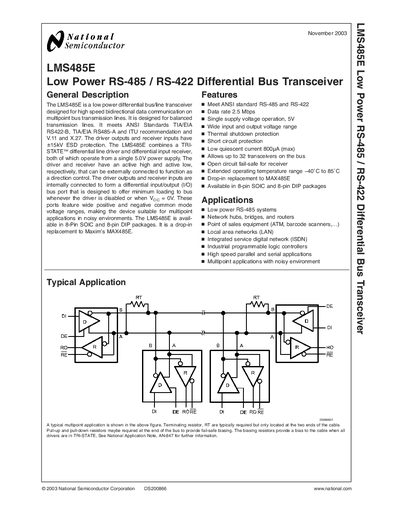
The LMS485E is a low‑power differential bus transceiver designed for high‑speed bidirectional data communication on multipoint RS‑485/RS‑422 lines. It meets ANSI TIA/EIA RS‑422‑B, RS‑485‑A, ITU V.11 and X.27 standards and includes +15 kV ESD protection on driver outputs and receiver inputs.
Key features include a single 5 V supply, low quiescent current, thermal shutdown and short‑circuit protection, and availability in 8‑pin SOIC and 8‑pin DIP packages. The device supports up to 32 transceivers on a bus and offers fail‑safe biasing for noisy environments.
| Maximum data rate | 2.5 Mbps |
|---|---|
| Supply voltage | 5 V (single supply) |
| Low quiescent current | 800 µA (max) |
| Operating temperature range | -40 °C to 85 °C |
| Package options | 8‑Pin SOIC and 8‑Pin DIP |
| ESD protection | +15 kV on driver outputs and receiver inputs |
The LMS485E supports a maximum data rate of 2.5 Mbps.
It operates from a single 5 V supply.
The device is offered in 8‑Pin SOIC and 8‑Pin DIP packages.
Up to 32 LMS485E transceivers can be connected on the bus.