
This is a Nikon 35mm film scanner LS-30 user manual, which introduces safety precautions, installation and storage, the scanner's various parts, installation and connection of power cable and SCSI cable, scanner usage, maintenance cleaning and storage
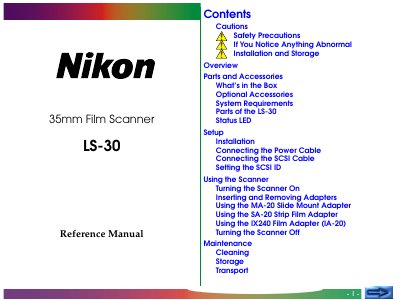
The LS-30 is a 35 mm film scanner that supports both slide and strip film formats. This reference manual covers all aspects of using the scanner, from safety precautions to detailed specifications.
Key sections include safety warnings, installation and storage guidelines, connection of power and SCSI cables, operation of various film adapters, routine maintenance, troubleshooting tips, and a full list of technical specifications.
| Supported film type | 35 mm film (slides and strip film) |
|---|---|
| Scanning system | Fixed‑film, movable plane‑scanning single‑pass optical system |
| Image sensor | 2592 linear‑pixel CCD |
| Light source | Red, green, and blue (RGB) LEDs |
| Maximum optical resolution | 2700 dpi (2700 pixels/25.4 mm) at film surface |
| Pixel size | Rectilinear 11 µm pixels |
| Output format | Full color, 8 bits per color |
| Interface | SCSI‑2 compliant, half‑pitch 50‑pin connectors (x2) |
| Dimensions | 85.5 mm W × 275.0 mm D × 142.0 mm H |
| Weight | Approx. 2.4 kg (5 lb 5.7 oz) |
| Power supply | 100–240 VAC, 0.3–0.2 A, 50/60 Hz |
| Operating temperature | +10 °C to +35 °C (50 °F to 95 °F) |
| Humidity range | 20 % to 85 % (no condensation) |
Do not insert fingers, hair, or clothing into the film slot, use a proper AC power supply, ground the outlet, and keep the scanner on a stable, horizontal surface.
Connect the supplied SCSI cable to the scanner and the computer, then set the appropriate SCSI ID before powering on the unit.
The scanner can achieve up to 2700 dpi (2700 pixels per 25.4 mm) at the film surface.