
The MC10EP/100EP52 is a differential data, differential clock D flip-flop. The device is pin and functionally equivalent to the EL52 device. Data enters the master portion of the flip-flop when the clock is LOW and is transferred to the slave, and thus the outputs, upon a positive transition of the clock. The differential clock inputs of the EP52 allow the device to also be used as a negative edge triggered device. The EP52 employs input clamping circuitry so that under open input conditions (pulled down to VEE) the outputs of the device will remain stable. The 100 Series contains temperature compensation. Features: 330 ps Typical Propagation Delay, Maximum Frequency - 4 GHz Typical, PECL Mode: VCC = 3.0 V to 5.5 V with VEE = 0 V, NECL Mode: VCC = 0 V with VEE = -3.0 V to -5.5 V, Open Input Default State, Safety Clamp on Inputs, Q Output Will Default LOW with Inputs Open or at VEE, Pb-Free Packages are Available.
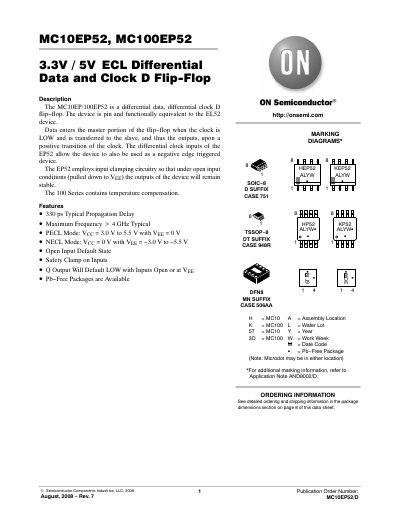
The MC10EP/100EP52 devices are differential data, differential clock D flip‑flops that are pin‑compatible with the EL52 family. Data is captured on the low‑level clock and transferred to the slave on the rising edge, while the differential clock inputs also allow negative‑edge operation. The devices include input‑clamping circuitry to keep outputs stable when inputs are open.
The datasheet provides typical propagation delay of 330 ps, maximum operating frequency of 4 GHz, and full DC and AC characteristic tables for PECL, NECL, and temperature ranges. Package options include SOIC‑8, TSSOP‑8, and DFN8, with both standard and Pb‑Free versions, and ordering information is listed for each package type. This manual is written in Chinese.
| Typical Propagation Delay | 330 ps |
|---|---|
| Maximum Frequency (PECL mode) | 4 GHz |
| Power Supply Current (IEE) typical | 34 mA |
| Operating Temperature Range | -40 °C to +85 °C |
| Maximum VCC (PECL mode) | 6 V |
| Pb‑Free Packages Available | Yes |
The devices are offered in SOIC‑8, TSSOP‑8, and DFN8 packages, each with an 8‑lead pinout shown in the datasheet.
The typical propagation delay is 330 ps.
Yes, Pb‑Free versions of the packages are listed in the ordering information.