
This data sheet describes the features and characteristics of the SN54LVTH273/SN74LVTH273 low-voltage 8-bit D-type flip-flops.
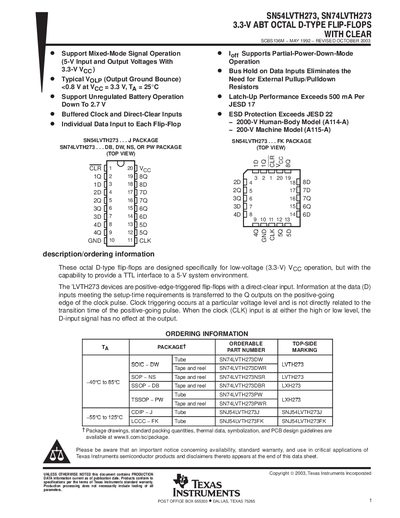
The SN54LVTH273 is an octal D‑type flip‑flop designed for low‑voltage (3.3 V) operation while providing TTL‑compatible I/O for 5‑V systems. The device features positive‑edge triggering, a direct‑clear input, bus‑hold circuitry, and partial‑power‑down capability.
The datasheet includes absolute maximum ratings, recommended operating conditions, electrical characteristics, timing parameters, switching behavior, and detailed packaging information for multiple package options (SOIC, SSOP, TSSOP, etc.).
| Supply voltage range (VCC) | -0.5 V to 4.6 V |
|---|---|
| Input voltage range (VI) | -0.5 V to 7 V |
| High‑state output current (IOH) | 48 mA (SN54LVTH273) |
| Low‑state output current (IOL) | 96 mA (SN54LVTH273) |
| Operating temperature range | -40 °C to 85 °C |
The device can be powered with a supply voltage from –0.5 V up to 4.6 V.
It is rated for operation between –40 °C and 85 °C.
It can source up to 48 mA per output when in the high state.
Yes, the device includes Ioff circuitry that disables the outputs for partial‑power‑down operation.