
CD74AC273 is the enhanced version of CD54AC273, which has faster transmission speed and lower power consumption. AC273 and ACT273 devices are octal D-type flip-flops with reset that utilize advanced CMOS logic technology. Information at the D input is transferred to the Q output on the positive-going edge of the clock pulse. All eight flip-flops are controlled by a common clock (CP) and a common reset (MR). Resetting is accomplished by a low voltage level independent of the clock.
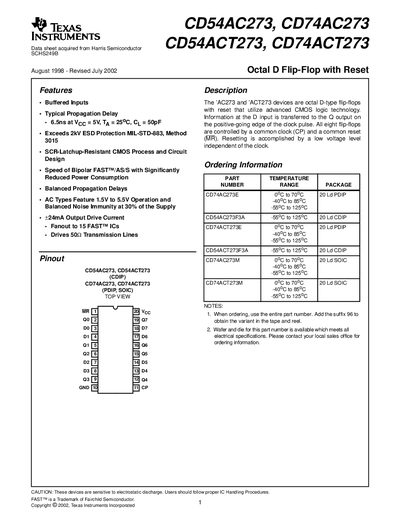
The CD54AC273, CD74AC273, CD54ACT273, and CD74ACT273 are octal D‑type flip‑flops with reset, built on a CMOS process that offers buffered inputs, low propagation delay, and high ESD protection. They operate from 1.5 V to 5.5 V, provide up to ±24 mA output drive, and support balanced propagation delays across all eight stages.
The devices are offered in various package types (PDIP, SOIC, TSSOP, etc.) with detailed ordering information, tape‑and‑reel options, and mechanical drawings. The datasheet also includes absolute maximum ratings, electrical specifications, switching characteristics, and a comprehensive notice on usage, handling, and warranty.
| Output Drive Current | ±24 mA |
|---|---|
| Propagation Delay (typical) | 154 ns (min) to 169 ns (max) at 1.5 V |
Each output can source or sink up to ±24 mA.
Typical propagation delay ranges from 154 ns to 169 ns.