
The MAX9124 is a quad low-voltage differential signaling (LVDS) line driver ideal for applications requiring high data rates, low power, and low noise. The MAX9124 is guaranteed to transmit data at speeds up to 800Mbps (400MHz) over controlled impedance media of approximately 100Ω. The transmission media may be printed circuit (PC) board traces, backplanes, or cables. The MAX9124 accepts four LVTTL/LVCMOS input levels and translates them to LVDS output signals. Moreover, the MAX9124 is capable of setting all four outputs to a high-impedance state through two enable inputs, EN and EN, thus dropping the device to an ultra-low-power state of 16mW (typ) during high impedance. The enables are common to all four transmitters. Outputs conform to the ANSI TIA/EIA-644 LVDS standard. The MAX9124 operates from a single +3.3V supply and is specified for operation from -40°C to +85°C. It is available in 16-pin TSSOP and SO packages. Refer to the MAX9125/ MAX9126 data sheet for quad LVDS line receivers.
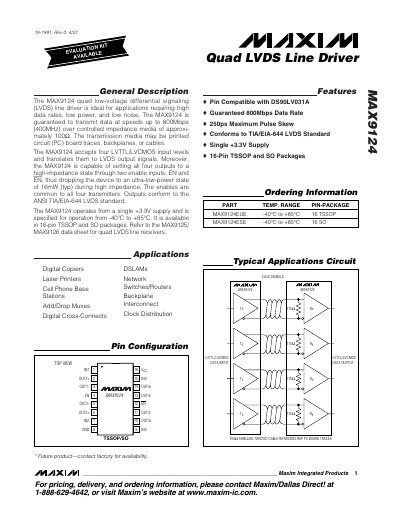
The MAX9124 quad low‑voltage differential signaling (LVDS) line driver is designed for high‑speed, low‑power applications. It accepts four LVTTL/LVCMOS inputs and converts them to LVDS outputs, supporting data transmission up to 800 Mbps (400 MHz) over a 100 Ω controlled‑impedance medium.
Key features include operation from a single +3.3 V supply, a typical ultra‑low power consumption of 16 mW in high‑impedance mode, and availability in 16‑pin TSSOP and SO packages. The device operates from –40 °C to +85 °C and provides differential output voltage of 250 mV with a maximum operating frequency of 400 MHz.
| Maximum Data Rate | 800 Mbps (400 MHz) |
|---|---|
| Supply Voltage | +3.3 V (single supply) |
| Operating Temperature Range | -40 °C to +85 °C |
| Package Types | 16‑Pin TSSOP and SO |
The MAX9124 can transmit data at speeds up to 800 Mbps (400 MHz).
It operates from a single +3.3 V supply.
The device is a quad driver, offering four LVTTL/LVCMOS input channels and four LVDS output channels.
It is offered in 16‑pin TSSOP and SO packages.