
The MAX9115 is a low-voltage differential signaling (LVDS) line receiver ideal for applications requiring high data rates, low power, and low noise. The device is guaranteed to receive data at speeds up to 200Mbps (100MHz). The MAX9115 accepts an LVDS differential input and translates it to an LVTTL/LVCMOS output. The fail-safe feature sets the output high when the inputs are undriv- en and open, terminated, or shorted. The device sup- ports a wide common-mode input range, allowing a ground potential difference and common-mode noise between the driver and the receiver. The MAX9115 conforms to the ANSI TIA/EIA-644 LVDS standard. The MAX9115 operates from a single +3.3V supply, and is specified for operation from -40°C to +85°C. It is available in a space-saving 5-pin SC70 package. Refer to the MAX9110/MAX9112 data sheet for single/dual LVDS line drivers.
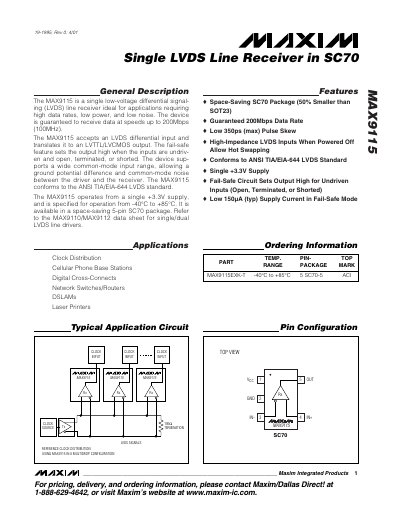
The MAX9115 is a single low‑voltage differential signal (LVDS) line receiver designed for applications that need high data rates, low power consumption, and low noise. It accepts LVDS differential inputs and converts them to LVTTL/LVCMOS outputs, operating from a single +3.3 V supply and supporting temperatures from –40 °C to +85 °C.
Key features include a guaranteed 200 Mbps (100 MHz) data rate, fail‑safe output that goes high when inputs are open or shorted, and a compact 5‑pin SC70 package. The device requires an external termination resistor (typically 100 Ω) and benefits from controlled‑impedance board layout to maintain signal integrity.
| Maximum Data Rate | 200 Mbps (100 MHz) |
|---|---|
| Supply Voltage | +3.3 V |
| Operating Temperature Range | -40 °C to +85 °C |
| Fail‑Safe Supply Current (typ) | 150 µA |
| Input Differential Voltage Range | 0.05 V to 1.0 V |
| Typical Propagation Delay | 1.2 ns |
The MAX9115 can receive data at speeds up to 200 Mbps (100 MHz).
It operates from a single +3.3 V supply.
When inputs are open, undriven, terminated, or shorted, the fail‑safe circuit sets the output high and reduces supply current.
A termination resistor of typically 100 Ω (range 90 Ω to 132 Ω) should be used.