
The MAX13051 ±80V fault-protected CAN transceiver with autobaud is ideal for device net and other industrial network applications where overvoltage protection is required. The MAX13051 provides a link between the CAN protocol controller and the physical wires of the bus lines in a control area network (CAN). The MAX13051 features three different modes of operation: high speed, slope control, and standby. High-speed mode allows data rates up to 1Mbps. The slope-control mode can be used to program the slew rate of the transmitter for data rates of up to 500kbps, reducing the effects of EMI and allowing the use of unshielded-twisted or parallel cable. In standby mode, the transmitter shuts off and a low-power receiver monitors the bus, waiting for a wake-up signal. The MAX13051 provides a transmitter data (TXD) dominant timeout function that prevents erroneous CAN controllers from clamping the bus to a dominant level if the TXD input is held low for greater than 1ms. The MAX13051 also provides an autobaud feature allowing the microcontroller to compute the incoming baud rate without destroying CAN protocol communication. The MAX13051 input common-mode range is greater than ±12V, exceeding the ISO 11898 specification of -2V to +7V, and features ±6kV Human Body Model protection, making these devices ideal for harsh environments. The MAX13051 is available in an 8-pin SO package and is specified from the -40°C to +85°C and -40°C to +125°C temperature range.
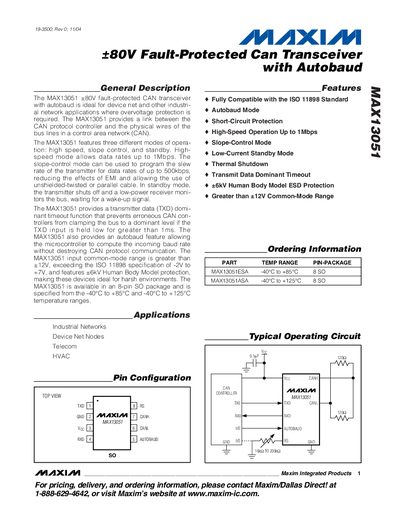
The MAX13051 is a +80 V fault‑protected CAN transceiver fully compatible with ISO 11898. It offers three operation modes—high‑speed (up to 1 Mbps), slope‑control (up to 500 kbps), and standby—plus an autobaud feature that lets a microcontroller determine the bus baud rate without disrupting communication. The device includes dominant‑timeout protection and +6 kV human‑body‑model ESD protection, making it suitable for harsh industrial networks.
The datasheet provides absolute maximum ratings, DC electrical characteristics, timing diagrams, pin descriptions, and package dimensions. Key specifications include a supply voltage of +5 V, standby current of about 15 µA, operating temperature from –40 °C to +125 °C, and a 1400‑transistor BiCMOS process. Mechanical drawings and layout recommendations are also included.
| Fault Protection Voltage | +80 V |
|---|---|
| High‑Speed Data Rate | Up to 1 Mbps |
| Standby Supply Current | 15 µA |
| ESD Protection (Human Body Model) | +6 kV |
The MAX13051 can transmit at up to 1 Mbps in high‑speed mode.
All inputs are protected to a Human Body Model rating of +6 kV.
When AUTObaud is high, TXD is looped back to RXD so the microcontroller can compute the incoming baud rate without affecting CAN communication.