
The NCP1200 is a PWM current-mode controller designed for low-power universal off-line supplies. It allows the implementation of a complete offline battery charger or a standby SMPS with few external components due to its novel concept. The integrated output short-circuit protection enables the designer to build an extremely low-cost AC-DC wall adapter with a simplified feedback scheme. The controller operates at a fixed frequency of 40 kHz, 60 kHz, or 100 kHz and drives low gate-charge switching devices like an IGBT or a MOSFET, requiring very small operating power. The NCP1200 simplifies the design of reliable and cheap offline converters with low acoustic generation and pulse-by-pulse control thanks to its current-mode control. When the current setpoint falls below a certain value, such as when the output power demand decreases, the IC automatically enters the skip cycle mode, providing excellent efficiency at light loads. This occurs at low peak current, resulting in no acoustic noise. The IC is self-supplied from the DC rail, eliminating the need for an auxiliary winding and ensuring operation even in the presence of low output voltage or shorts.
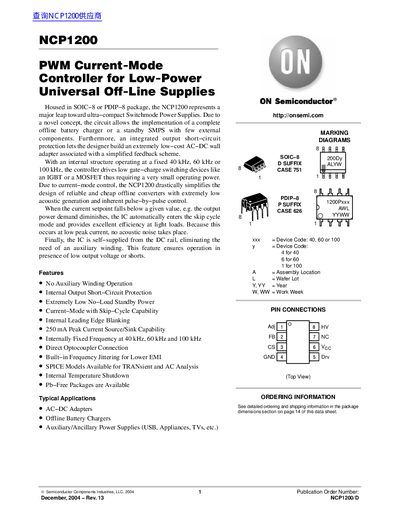
The NCP1200 is a PWM current‑mode controller designed for ultra‑compact low‑power offline supplies such as AC‑DC adapters and battery chargers. It operates with a fixed internal frequency of 40 kHz, 60 kHz or 100 kHz and includes features like internal short‑circuit protection, no auxiliary winding requirement, and built‑in frequency jittering for lower EMI.
The datasheet provides maximum ratings, electrical characteristics, pin descriptions, package dimensions for SOIC‑8 and PDIP‑8, and application notes on the Dynamic Self‑Supply principle and skip‑cycle mode, helping designers implement efficient, low‑cost power supplies.
| Fixed Operating Frequencies | 40 kHz, 60 kHz, 100 kHz |
|---|---|
| Peak Current Source/Sink Capability | 250 mA |
| Maximum Junction Temperature | 150 °C |
| Typical Output Voltage (Voc) | 11 V |
The skip‑cycle mode automatically skips switching cycles when the output power demand drops below a set level, improving efficiency at light loads.
The controller can operate at fixed frequencies of 40 kHz, 60 kHz, or 100 kHz.