
The TGF4112-EPU is a microwave amplifier from TriQuint with a typical output power of 6.0 watts, a nominal power added efficiency of 54.5%, and a nominal gain of 12.7 dB.
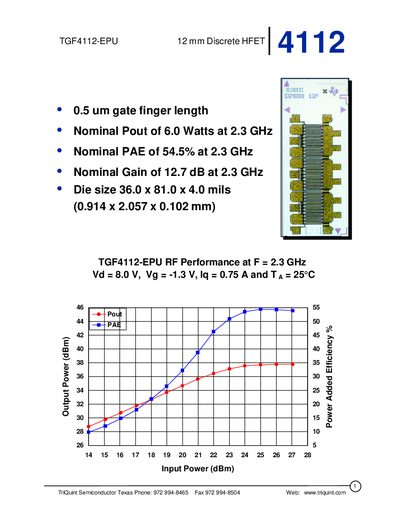
The TGF4112‑EPU is a 12 mm discrete HFET from TriQuint designed for high‑frequency power amplification around 2.3 GHz. The document provides RF performance curves, DC characteristics, a linear model, thermal model, mechanical drawing, and a typical application circuit.
Key specifications include a nominal output power of 6 W, PAE of 54.5 %, gain of 12.7 dB, die size 36 × 81 × 4 mil, IDSS 2.94 A, and breakdown voltages of –22 V. Recommended bonding (three gate bonds, six drain bonds) and layout details are also listed.
| Nominal Output Power | 6.0 Watts at 2.3 GHz |
|---|---|
| Power Added Efficiency | 54.5 % at 2.3 GHz |
| Gain | 12.7 dB at 2.3 GHz |
| Die Size | 36.0 × 81.0 × 4.0 mils (0.914 × 2.057 × 0.102 mm) |
| Drain Saturation Current (IDSS) | 2940 mA |
| Transconductance (GM) | 1980 mS |
| Pinch‑Off Voltage (VP) | -1.85 V |
| Gate‑Source Breakdown Voltage (BVGS) | -22 V |
| Gate‑Drain Breakdown Voltage (BVGD) | -22 V |
| Recommended Bonds | 3 gate bonds, 6 drain bonds |
The nominal output power is 6.0 Watts at 2.3 GHz.
Three gate bonds and six drain bonds are recommended for operation.
The die measures 36.0 × 81.0 × 4.0 mils (0.914 × 2.057 × 0.102 mm).