
The TriQuint TGS8122-SCC is a monolithic single-pole, double-throw (SPDT) GaAs FET switch designed for 8 to 11 GHz. It has low insertion loss, low current consumption, and fast rise/fall time, making it ideal for high-speed switching radar and communication systems.
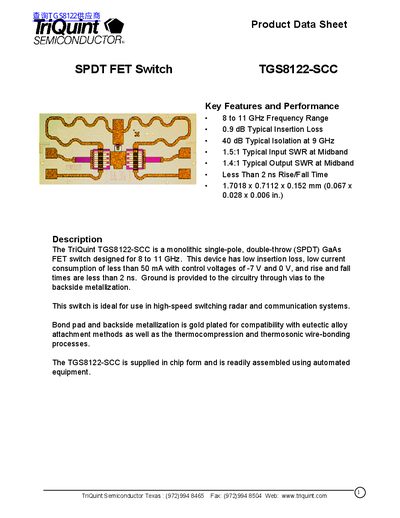
The TriQuint TGS8122‑SCC is a monolithic single‑pole, double‑throw (SPDT) GaAs FET switch designed for 8 to 11 GHz operation. It offers a typical insertion loss of 0.9 dB, 40 dB isolation at 9 GHz, input and output SWR of 1.5:1 and 1.4:1 respectively, and rise/fall times under 2 ns. The device consumes less than 50 mA with control voltages of –7 V and 0 V.
The switch is supplied in a compact chip package (1.7018 × 0.7112 × 0.152 mm) with gold‑plated bond pads for eutectic, thermocompression, or thermosonic wire‑bonding. It is intended for high‑speed radar and communication systems and includes recommended RF assembly diagrams and mechanical drawings.
| Frequency Range | 8 to 11 GHz |
|---|---|
| Typical Insertion Loss | 0.9 dB |
| Typical Isolation at 9 GHz | 40 dB |
| Typical Input SWR (midband) | 1.5:1 |
| Typical Output SWR (midband) | 1.4:1 |
| Rise/Fall Time | < 2 ns |
| Control Voltages | -7 V and 0 V |
| Current Consumption | < 50 mA |
| Package Dimensions | 1.7018 x 0.7112 x 0.152 mm |
It operates from 8 GHz to 11 GHz.
The typical insertion loss is 0.9 dB.
It provides about 40 dB of isolation at 9 GHz.
The rise and fall times are less than 2 ns.