
The MAX9600/MAX9601/MAX9602 ultra-high-speed comparators feature extremely low propagation delay (500ps). These dual and quad comparators minimize propagation delay skew (10ps) and are designed for low propagation delay dispersion (30ps). These features make them ideal for applications where high-fidelity tracking of narrow pulses and low timing dispersion is critical. The differential input stage accepts a wide range of signals in the common-mode range from (VEE + 3V) to (VCC - 2V). The outputs are complementary digital signals, compatible with ECL and PECL systems, and provide sufficient current to directly drive transmission lines terminated in 50Ω. The MAX9600/MAX9601 dual-channel ECL and dual-channel PECL output comparators incorporate latch enable (LE_, LE_), and hysteresis (HYS_). The complementary latch-enable control permits tracking, track-hold, or sample-hold mode of operations. The latch enables can be driven with standard ECL logic for MAX9600 and PECL logic for MAX9601. The MAX9602 quad-channel PECL output comparator is ideal for high-density packaging in limited board space. The MAX9600/MAX9601 are available in 20-pin TSSOP packages, and the MAX9602 is offered in a 24-pin TSSOP package. The MAX9600/MAX9601/MAX9602 are specified for operation from -40°C to +85°C.
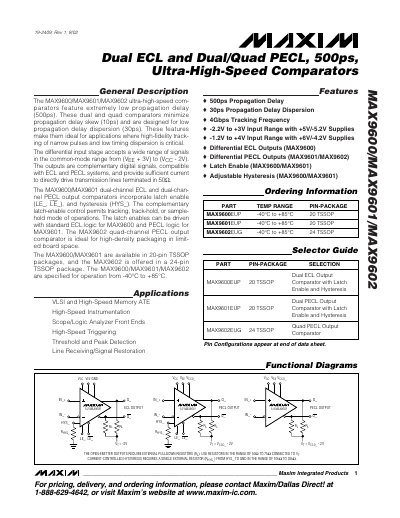
The MAX9600, MAX9601, and MAX9602 are ultra‑high‑speed comparators with extremely low propagation delay (500ps) and minimal skew (10ps). They feature differential input stages, latch‑enable and hysteresis (MAX9600/9601), and dual‑ or quad‑channel PECL/ECL outputs suitable for high‑frequency signal processing up to 4 Gbps.
These devices operate from -5.2 V/+5 V (or shifted -4.2 V/+6 V) and are specified for -40 °C to +85 °C. Recommended PCB layout includes low‑inductance ground planes, close decoupling capacitors, and controlled differential impedance to maintain signal integrity. The datasheet includes pin descriptions, timing diagrams, and detailed electrical parameters for design reference.
| Propagation Delay | 500 ps |
|---|---|
| Propagation Delay Skew | 10 ps |
| Tracking Frequency | 4 Gbps |
| Input Common‑Mode Range | VEE+3 V to VCC‑2 V |
| Operating Temperature Range | -40 °C to +85 °C |
| Package Types | 20‑pin TSSOP (MAX9600/9601), 24‑pin TSSOP (MAX9602) |
The MAX9600 has a propagation delay of 500 ps.
The input common‑mode range is from VEE+3 V to VCC‑2 V.
An input slew rate of 5 V/µs or faster is required for the MAX9600.
Latch‑enable allows the comparator to operate in tracking mode or latch (sampling) mode, fixing the output when the latch input is high.