
The ADM485 is a high performance RS-485 transceiver with a single 5V supply and a –7V to +12V common-mode range. It features thermal shutdown protection and short-circuit protection.
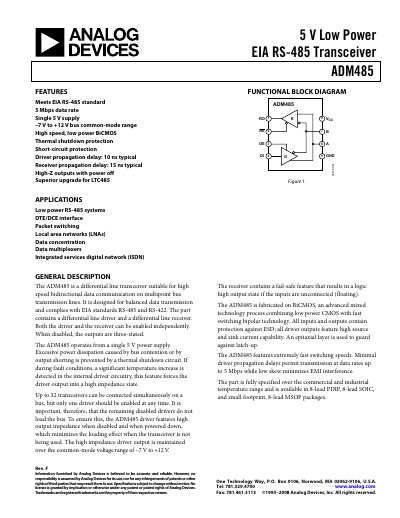
The ADM485 is a differential line transceiver designed for high‑speed bidirectional data communication on multipoint bus lines. It operates from a single 5 V supply, supports a common‑mode range of –7 V to +12 V, and includes thermal‑shutdown and short‑circuit protection.
The device is offered in 8‑lead PDIP, SOIC and MSOP packages, supports up to 32 devices on a bus, and meets EIA RS‑485 and RS‑422 standards. Detailed specifications, timing parameters, pin functions and typical performance curves are provided in the document.
| Supply Voltage | 5 V ±5 % |
|---|---|
| Operating Temperature Range (industrial) | –40 °C to +85 °C |
| Maximum Data Rate | 5 Mbps |
| Protection Features | Thermal shutdown, short‑circuit protection |
| Package Options | 8‑lead PDIP, 8‑lead SOIC, 8‑lead MSOP |
It operates from a single 5 V supply with a tolerance of ±5 %.
The device supports up to 5 Mbps data rate meeting the EIA RS‑485 standard.
It includes thermal‑shutdown protection and short‑circuit protection to prevent damage.