
ADN4667 is a quad, CMOS, low voltage differential line driver with features such as high ESD protection, high switching rates, simplified PCB layout, low power dissipation, interoperability with existing 5V LVDS receivers, etc.
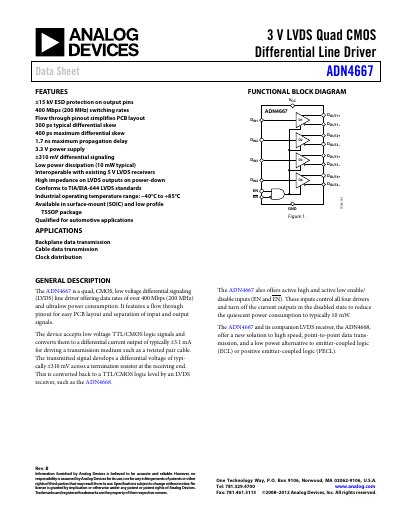
The ADN4667 is a quad, CMOS, low‑voltage differential signaling (LVDS) line driver offering data rates up to 400 Mbps (200 MHz) with ultra‑low power consumption. It features a flow‑through pinout for easy PCB layout, ±15 kV ESD protection on output pins, and is qualified for automotive use.
The document provides full electrical specifications, pin descriptions, typical performance curves, ordering information, and an automotive product variant. It also includes application guidance for backplane, cable data transmission, and clock distribution.
| Supply Voltage (VCC) Range | 3.0 V to 3.6 V |
|---|---|
| Typical Differential Output Voltage (VOD) | 310 mV |
| Typical Propagation Delay (High‑to‑Low) | 0.9 ns |
| Typical No‑Load Supply Current (Drivers Enabled) | 8.0 mA |
| ESD Protection (Output Pins) | ±15 kV |
The device operates from 3.0 V to 3.6 V supply voltage.
Typical differential output voltage is 310 mV.
The driver supports data rates of up to 400 Mbps (200 MHz) switching rates.
Yes, the ADN4667W model is qualified for automotive applications.