
The PICDEM 4 Demonstration Board supports Microchip's low pin-count PICmicro FLASH microcontrollers, including the PIC16F and PIC18F families featuring nanoWatt Technology. The demonstration board showcases many features of low pin-count parts, including Local Interconnect Network (LIN) and motor control features using the enhanced capture/compare/PWM module (ECCP). Low-power operation is achieved with a supercapacitor circuit and jumpers allow the on-board hardware to be disabled to eliminate current draw in this mode.
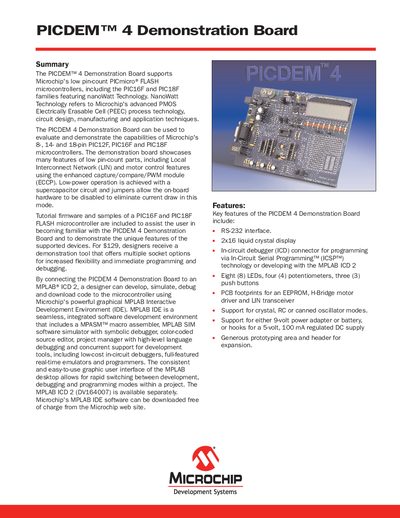
The PICDEM 4 Demonstration Board supports Microchip’s low pin‑count PICmicro™ FLASH microcontrollers, including PIC16F and PIC18F families. It showcases LIN, motor‑control, and low‑power operation with a super‑capacitor circuit, and provides connectors for RS‑232, a 2×16 LCD, LEDs, potentiometers, push‑buttons, and expansion headers.
The handbook lists the package contents (board, serial cable, two microcontroller samples, CD‑ROM), host system requirements (Pentium‑class PC, 16 MB RAM, 40 MB free disk, serial port, Windows 98/2000/XP), and the Microchip development tools (MPLAB IDE, MPASM, MPLINK, C compilers, simulators, ICD 2, etc.) needed to program and debug the board.
| Interface | RS‑232 |
|---|---|
| Display | 2×16 liquid crystal display |
| LEDs | Eight (8) LEDs |
| Footprints | EEPROM, H‑Bridge motor driver, LIN transceiver |
| Oscillator support | Crystal, RC or canned oscillator modes |
| Power options | 9‑V adapter or battery, or 5‑V 100 mA regulated DC supply |
| Prototyping area | Generous prototyping area and header for expansion |
The board supports Microchip’s low pin‑count PICmicro™ FLASH microcontrollers, including the PIC16F and PIC18F families.
The package contains the PICDEM 4 PCB, a serial cable, two PICmicro FLASH microcontroller samples, and a CD‑ROM with sample programs and documentation.
It can be programmed via the In‑Circuit Serial Programming (ICSP) connector using an ICD, or with the MPLAB ICD 2 debugger and MPLAB IDE software.