
National Semiconductor LM1893/LM2893 Carrier-Current Transceiver Handbook

This is a datasheet about LM1893 and LM2893
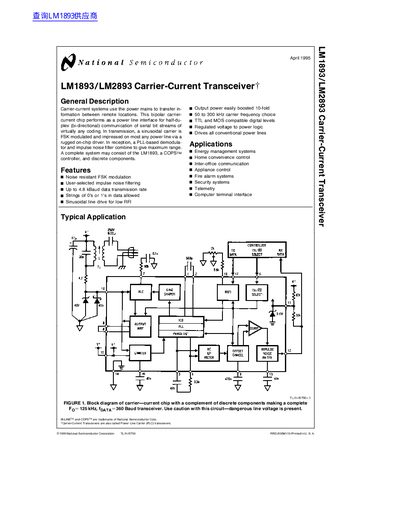

National Semiconductor LM1893/LM2893 Carrier-Current Transceiver Handbook - cover page
Brand
National Semiconductor
Category
Other Electronics
Document type
User Manual
Language
English
Pages
24
File format
PDF
File size
579 KB
Published
04 May, 2012
Updated
30 September, 2023
Models
LM1893, LM2893
MD5 checksum
F9EDC877E114CA9E7AE33BF8848E21CC

About this manual

The handbook describes the LM1893 and LM2893 carrier‑current transceiver chips, which use the power mains to transfer data between remote locations. It explains the bi‑directional operation, FSK modulation, and the on‑chip driver that can handle 50 to 300 kHz carrier frequencies.

The document includes absolute maximum ratings, electrical characteristics for both transmitter and receiver modes, typical performance curves, and application guidance for integrating the chip into power‑line communication systems.

What's inside

  • General Description
  • Typical Application
  • Absolute Maximum Ratings
  • General Electrical Characteristics
  • Transmitter Electrical Characteristics
  • Receiver Electrical Characteristics
  • Typical Performance Characteristics
  • Application Information
  • Recommended Purpose

Specifications

Supply voltage (maximum)30 V
Operating ambient temperature range-40 °C to 85 °C
Maximum continuous dissipation (transmit mode)1.66 W
Maximum continuous dissipation (receive mode)1.33 W
Data transmission rateup to 4.8 kBaud
Carrier frequency range50 kHz to 300 kHz

Frequently asked questions

What is the maximum supply voltage for the LM1893/LM2893?

The maximum supply voltage is 30 V.

What is the ambient temperature range for operation?

The device operates from –40 °C to 85 °C.

What data transmission rate can the transceiver achieve?

It can transmit data at up to 4.8 kBaud.

What carrier‑frequency range does the chip support?

The chip supports carrier frequencies from 50 kHz to 300 kHz.

Download PDF (579 KB)

More National Semiconductor Manuals


View all National Semiconductor manuals →