
Vishay Siliconix current-sensing power MOSFETs offer a simple means of incorporating a protection feature into an electronic control circuit and avoiding catastrophic failures resulting from overcurrent (overload) and/or short-circuit conditions. The device package is a modified D2PAK with five pins. The MOSFET termination retains the standard D2PAK footprint for a three-pin device. The additional two pins provide termination for a current-sense output and an internal Kelvin connection to the source. For current sensing, the MOSFET design employs a small number of the total number of MOSFET cells in a known ratio. The latter define the current-sense parameters. A typical control interface uses a simple circuit with an op-amp or a comparator. This approach offers the freedom of control-level setting and facilitates its incorporation into the main control system.
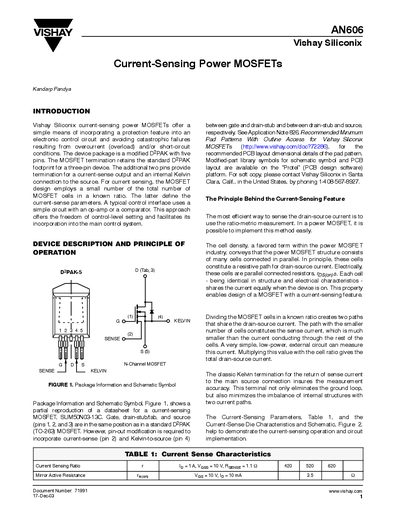
The AN606 is a current‑sensing power MOSFET from Vishay Siliconix that integrates a Kelvin‑sense terminal and a dedicated current‑sense output. Its modified D2PAK‑5 package provides five pins, keeping the standard D2PAK footprint while adding the sense and Kelvin connections.
The document describes the device operation, key parameters such as the current‑sense ratio, mirror active resistance, and provides design equations and example circuits for supervisory over‑current and short‑circuit protection applications.
| Package | Modified D2PAK‑5 (5 pins) |
|---|---|
| Current‑sense ratio (r) | Quotient of sense‑terminal cells to total cells |
It is defined as the quotient of the number of cells terminated on the sense terminal to the total number of cells on the MOSFET die.
The AN606 uses a modified D2PAK‑5 package with five pins, keeping the standard D2PAK footprint while adding sense and Kelvin connections.
It is intended for supervisory protection functions such as over‑current and short‑circuit protection, not for precise current‑control loops.