
OLED is a new generation display technology that can achieve brighter and clearer full-color images with faster response speed. It emits light through the principle of organic materials emitting light under the action of an electric field.
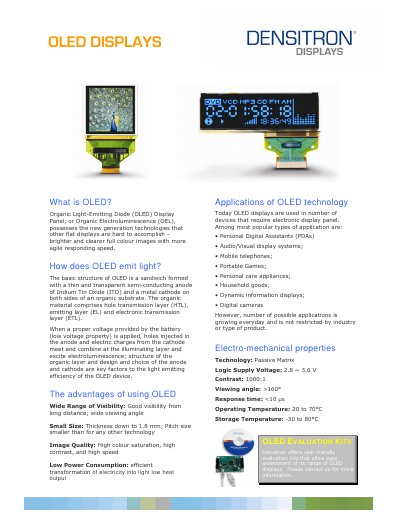
Organic Light‑Emitting Diode (OLED) display panels use a sandwich structure of a transparent ITO anode, a metal cathode and organic layers (hole‑transmission, emitting and electron‑transmission). This design provides bright, clear full‑colour images, wide viewing angles, low power consumption and fast response.
The leaflet lists technical specifications such as passive‑matrix logic, 2.8‑3.6 V supply voltage, 1000:1 contrast, >160° viewing angle, <10 µs response time, and operating temperatures from 20 °C to 70 °C. It also includes a table of Densitron OLED modules (e.g., DD‑6448BE‑1B, SSD1303T5) with screen sizes, resolutions and dimensions, plus contact information for Densitron Display Solutions.
| Technology | Passive Matrix Logic |
|---|---|
| Supply Voltage | 2.8 ~ 3.6 V |
| Contrast | 1000:1 |
| Viewing Angle | >160° |
| Response Time | <10 µs |
| Operating Temperature | 20 to 70°C |
| Storage Temperature | -30 to 80°C |
It is a sandwich formed with a thin transparent ITO anode, a metal cathode, and an organic substrate containing hole‑transmission, emitting, and electron‑transmission layers.
An OLED panel operates at a supply voltage of 2.8 to 3.6 volts.