
The ADL5513 is a single-chip solution for RF transmitter power amplifier linearization and gain/power control, power monitoring in radio link transmitters, and RSSI measurement in base stations, WLAN, WiMAX, and RADAR.
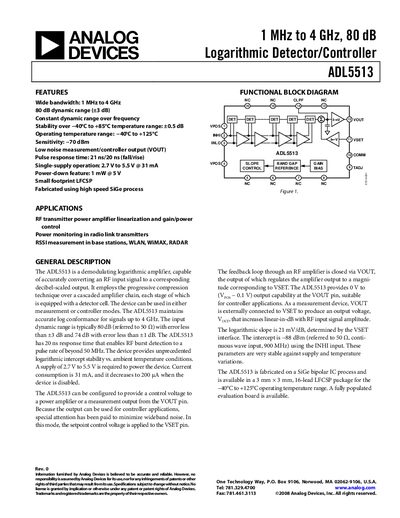
The ADL5513 is a demodulating logarithmic amplifier that converts RF input signals to a decibel‑scaled output. It can be used in measurement or controller modes for applications such as RF transmitter power‑amplifier linearization, power monitoring, and RSSI measurement in base stations, WLAN, WiMAX and radar systems.
Key features include a 1 MHz‑to‑4 GHz bandwidth, 80 dB dynamic range, 2.7 V‑to‑5.5 V single‑supply operation, 21 ns pulse response time, and a logarithmic slope of 21 mV/dB. Detailed specifications, pin descriptions, absolute maximum ratings, and calibration procedures are provided.
| Bandwidth | 1 MHz to 4 GHz |
|---|---|
| Dynamic range (typical) | 80 dB |
| Supply voltage | 2.7 V to 5.5 V |
| Pulse response time | 21 ns fall, 20 ns rise |
| Logarithmic slope | 21 mV/dB |
| Input impedance | 1.3 kΩ/0.4 kΩ pF |
| Operating temperature range | –40 °C to +125 °C |
The device operates from a single supply of 2.7 V to 5.5 V.
The pulse response time is 21 ns for the fall edge and 20 ns for the rise edge.
The logarithmic slope is 21 mV per dB.