
The AD8315 is a complete low cost subsystem for the precise control of RF power amplifiers operating in the frequency range 0.1 GHz to 2.5 GHz and over a typical dynamic range of 50 dB. It is intended for use in cellular handsets and other battery-operated wireless devices.
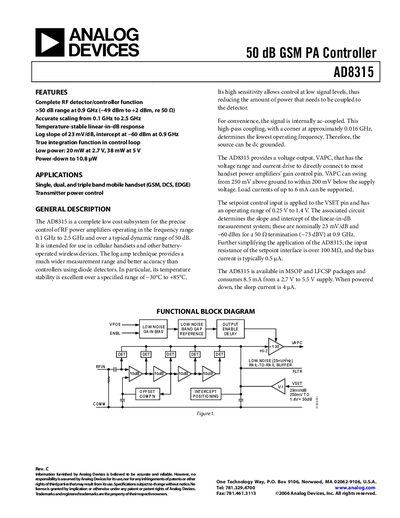
The AD8315 is a complete low‑cost subsystem for precise control of RF power amplifiers in the 0.1 GHz‑2.5 GHz range, offering a typical 50 dB dynamic range. It is intended for cellular handsets and other battery‑operated wireless devices, with temperature‑stable linear‑in‑dB response.
The device supplies a voltage output (VAPC) that can directly drive handset power‑amplifier gain pins, and a setpoint input (VSET) with a 0.25 V‑1.4 V range. Pin functions, typical performance curves, and ordering options are detailed in the handbook.
| Frequency Range | 0.1 GHz – 2.5 GHz |
|---|---|
| Supply Voltage (VPOS) | 2.7 V – 5.5 V |
| Quiescent Current (ENBL high) | 8.5 mA typical |
| Input Resistance (VSET) | 100 kΩ |
| Logarithmic Slope | 23 mV/dB |
The AD8315 provides a dynamic range of greater than 50 dB.
It operates from a supply voltage between 2.7 V and 5.5 V.
The typical quiescent current with ENBL high is about 8.5 mA.