
The AD8319 is a demodulating logarithmic amplifier, capable of accurately converting an RF input signal to a logarithmic output, which can be used for power control and level monitoring applications.
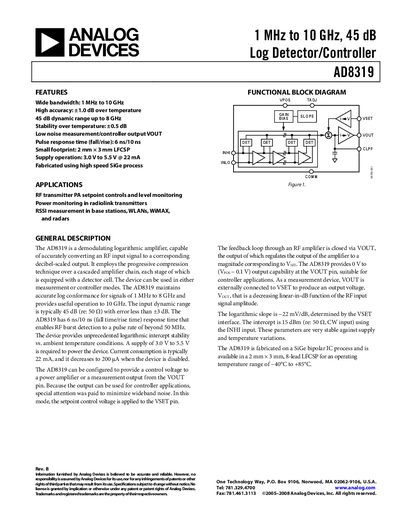
The AD8319 is a demodulating logarithmic amplifier that converts RF input signals from 1 MHz to 10 GHz into a decibel‑scaled output. It can operate in measurement or controller mode, providing a stable log‑conformance over temperature and a wide dynamic range.
Key features include a 45 dB dynamic range up to 8 GHz, 6 ns fall/10 ns rise response time, supply voltage of 3.0 V‑5.5 V, and a compact 2 mm × 3 mm LFCSP package. The device is suited for RF transmitter PA set‑point control, power monitoring, RSSI measurement in base stations, WLAN, WiMAX, and radar systems.
| Frequency range | 1 MHz – 10 GHz |
|---|---|
| Dynamic range | 45 dB up to 8 GHz |
| Supply voltage | 3.0 V – 5.5 V |
| Quiescent current | 22 mA (typical) |
| Input impedance (typical) | 1500 Ω || 0.33 pF |
| Logarithmic slope (typical) | -22 mV/dB |
| Intercept (typical) | 15 dBm |
| High‑power output voltage (typical) | 0.57 V at –10 dBm input |
| Package | 8‑lead LFCSP, 2 mm × 3 mm |
The AD8319 operates from 3.0 V to 5.5 V supply voltage.
The device provides a 45 dB dynamic range up to 8 GHz.
The fall time is 6 ns and the rise time is 10 ns.