
This document describes the features and characteristics of the AD8042 dual 160 MHz rail-to-rail amplifier, including output swings, input voltage range, low power consumption, high speed and fast settling, and good video performance.
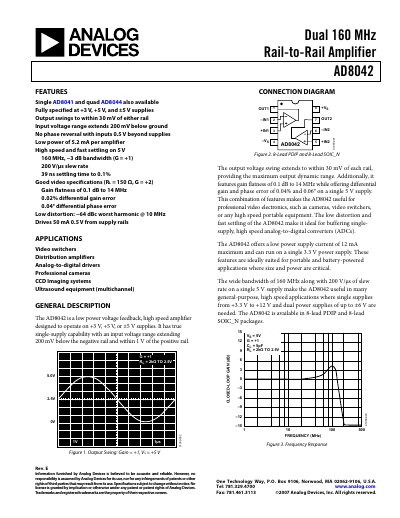
The AD8042 is a voltage‑feedback, high‑speed operational amplifier designed for single‑supply operation at +3 V, +5 V, or ±5 V. It offers rail‑to‑rail output swing, low power consumption (≈5.5‑6.4 mA per amplifier), and a 200 V/µs slew rate, making it suitable for video switchers, distribution amplifiers, and high‑speed ADC drivers.
The device is available in 8‑lead PDIP and 8‑lead SOIC packages. Detailed specifications include a 160 MHz -3 dB bandwidth, 39 ns settling time to 0.1 %, and input voltage range extending 200 mV below the negative rail. Typical performance graphs, layout recommendations, and application circuits such as composite video line drivers are provided.
| Bandwidth (-3 dB) | 160 MHz |
|---|---|
| Slew Rate | 200 V/µs |
| Supply Voltage Range | +3 V, +5 V, ±5 V |
| Quiescent Current (per amplifier) | 5.5–6.4 mA |
| Output Voltage Swing | within 30 mV of each rail |
| Input Voltage Range | 200 mV below negative rail, 1 V below positive rail |
The AD8042 has a typical -3 dB bandwidth of 160 MHz.
It can operate from +3 V, +5 V, or ±5 V supplies.
The quiescent current is between 5.5 mA and 6.4 mA per amplifier.
The output can swing to within 30 mV of either rail.