
The OP193/OP293 are micropower operational amplifiers that feature high precision, low supply current, and the ability to operate at low voltages. They offer high performance in single-supply systems, with input and output ranges including ground, and outputs swinging from the negative rail to within 600 mV of the positive supply. For low voltage operation, the OP193/OP293 can operate from +1.7 V to ±18 V.
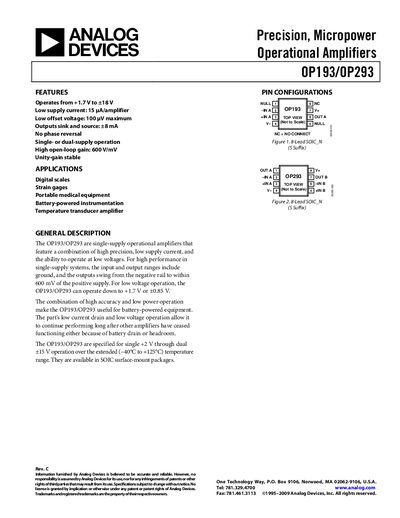
The OP193 and OP293 are single‑supply precision operational amplifiers designed for ultra‑low power operation. They operate from as low as +1.7 V up to +18 V, draw only 15 pA supply current, and offer offset voltages as low as 100 pV. Their output stage can source and sink up to ±8 mA, making them suitable for battery‑powered instrumentation, digital scales, strain‑gauge interfaces, and portable medical equipment.
The datasheet details electrical specifications, absolute maximum ratings, thermal resistance, and ESD precautions. It includes pin‑out diagrams for the 8‑lead SOIC package, typical performance curves, and an ordering guide. Engineers can use the provided parameters—such as gain‑bandwidth product, slew rate, and noise density—to design low‑noise, high‑accuracy analog front‑ends.
| Supply Voltage Range | +2 V to +18 V |
|---|---|
| Input Offset Voltage (OP193) | 150 µV |
| Input Offset Voltage (OP293) | 100 µV |
| Power Supply Rejection Ratio (PSRR) | 100 dB typical |
| Gain‑Bandwidth Product | 35 kHz |
| Slew Rate | 15 V/ms |
| Voltage Noise Density (1 kHz) | 65 nV/√Hz |
The devices operate from +2 V up to +18 V.
The OP293 has a typical input offset voltage of 100 µV.
Both amplifiers can source and sink up to +8 mA.
Typical PSRR is 100 dB (measured from +1.5 V to +18 V supply).