
The LM3500 is a synchronous step-up DC/DC converter designed specifically for white LED applications in cellular phone backlighting requiring low current and high efficiency.
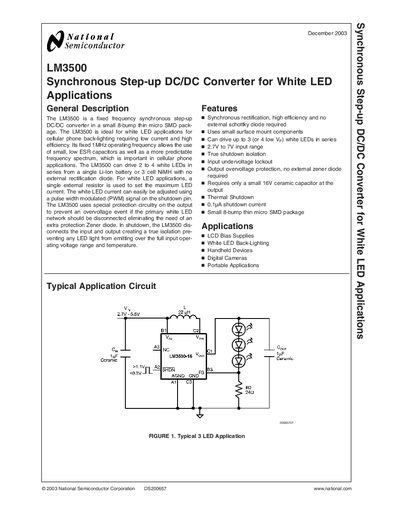
The LM3500 is a fixed‑frequency, synchronous step‑up DC/DC converter offered in a compact 8‑bump thin micro SMD package. It is designed for white LED applications such as cellular phone back‑lighting, LCD bias supplies, and handheld devices, providing up to 3‑4 LEDs in series from a single Li‑ion or NiMH battery.
Key features include synchronous rectification without an external Schottky diode, a 1 MHz switching frequency, true shutdown isolation, input undervoltage lockout, and over‑voltage protection. The device operates from 2.7 V to 7 V input and requires only a small 16 V ceramic capacitor at the output.
| Input voltage range | 2.7 V to 7 V |
|---|---|
| Switching frequency | 0.85 – 1.15 MHz |
| Package type | 8‑bump thin micro SMD |
| Maximum LED strings | Up to 3 or 4 low‑voltage white LEDs in series |
The LM3500 operates from 2.7 V to 7 V input.
It can drive up to three or four low‑voltage white LEDs in series.
The converter switches at a fixed 1 MHz, with typical values from 0.85 MHz to 1.15 MHz.