
The LTC2414/LTC2418 are 8-/16-channel (4-/8-differential) micropower 24-bit ∆Σ analog-to-digital converters. They operate from 2.7V to 5.5V and include an integrated oscillator, 2ppm INL and 0.2ppm RMS noise. They use delta-sigma technology and provide single cycle settling time for multiplexed applications. Through a single pin, the LTC2414/LTC2418 can be configured for better than 110dB differential mode rejection at 50Hz or 60Hz ±2%, or they can be driven by an external oscillator for a user-defined rejection frequency. The internal oscillator requires no external frequency setting components. The LTC2414/LTC2418 accept any external differential reference voltage from 0.1V to VCC for flexible ratiometric and remote sensing measurement applications. They can be configured to take 4/8 differential channels or 8/16 single-ended channels. The full-scale bipolar input range is from –0.5VREF to 0.5VREF. The reference common mode voltage, VREFCM, and the input common mode voltage, VINCM, may be independently set within GND to VCC. The DC common mode input rejection is better than 140dB. The LTC2414/LTC2418 communicate through a flexible 4-wire digital interface that is compatible with SPI and MICROWIRE TM protocols.
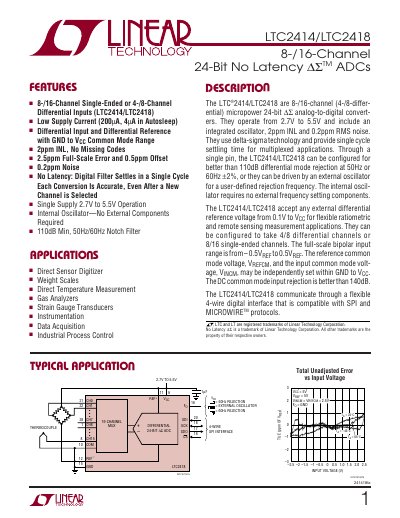
The LTC2414 and LTC2418 are micropower 24‑bit delta‑sigma analog‑to‑digital converters that operate from 2.7 V to 5.5 V. They offer 8‑ or 16‑channel (4‑ or 8‑differential) configurations, an integrated oscillator, 2 ppm INL, and 0.2 ppm RMS noise, making them suitable for multiplexed sensor applications.
This handbook contains detailed electrical characteristics, pin‑out diagrams, typical performance graphs, and absolute maximum ratings. It also lists ordering information, package options, and recommended external components for optimal operation.
| Supply Voltage (VCC) | 2.7 V to 5.5 V |
|---|---|
| Input Common Mode Rejection | >140 dB |
| Differential Input Voltage Range | –0.5 VREF to +0.5 VREF |
The devices operate from 2.7 V to 5.5 V.
The LTC2414/LTC2418 provide 8‑ or 16‑channel (4‑ or 8‑differential) configurations.
The device achieves better than 140 dB of DC common‑mode rejection.