
The AD420 is a complete digital to current loop output converter designed to meet the needs of the industrial control market. It provides a high precision, fully integrated, low cost single-chip solution for generating current loop signals in a compact 24-lead SOIC or PDIP package. The output current range can be programmed to 4 mA–20 mA, 0 mA–20 mA or 0 mA–24 mA.
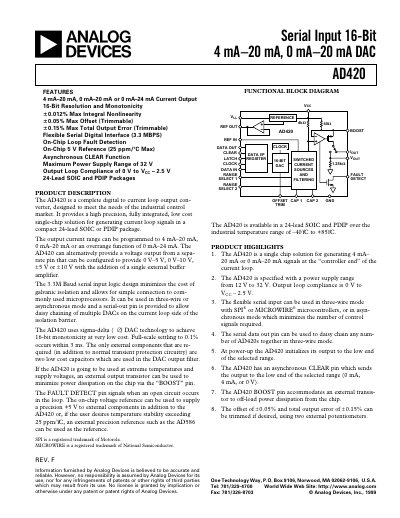
The AD420 is a single‑chip solution for generating precise current‑loop signals in industrial control applications. It offers 16‑bit resolution, a wide power‑supply range (12 V‑32 V) and flexible serial interfaces (three‑wire SPI/MICROWIRE or asynchronous mode). The device includes fault detection, on‑chip voltage reference, and optional voltage‑output mode via an external buffer.
The datasheet provides detailed specifications, pin descriptions, timing requirements, theory of operation, and application notes for both current‑mode and voltage‑mode configurations, including guidelines for external components and daisy‑chaining multiple devices.
| Resolution | 16 Bits |
|---|---|
| Power Supply Range | 12 V – 32 V |
| Integral Nonlinearity | -0.002 % – -0.012 % |
The AD420 operates with a supply voltage up to 32 V.
The AD420 provides 16‑bit resolution.