
The product is a dual 5A compound gate driver that can drive two N-channel MOSFETs. It has a 5A sinking current/3A source current capability, inputs and outputs can be connected in parallel, dual non-inverting, dual inverting and combination configurations, and has power rail under-voltage lockout protection, and is pin compatible with industry standard gate drivers.
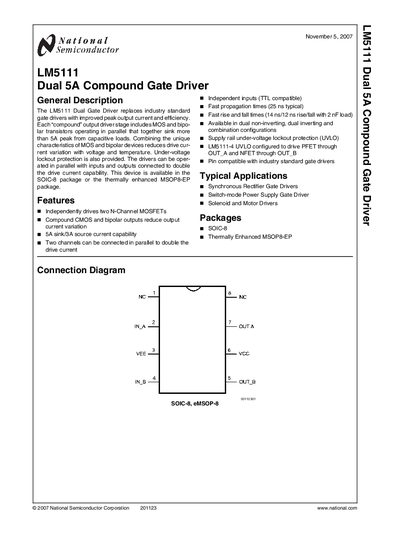
The LM5111 is a dual gate driver that combines MOS and bipolar transistors to provide high peak output current and improved efficiency. It offers independent control of two N‑Channel MOSFETs, 5 A sink/3 A source capability, and can be paralleled for doubled drive current. The device is supplied in SOIC‑8 or thermally enhanced MSOP8‑EP packages.
The document includes ordering information, pin descriptions, absolute maximum ratings, electrical characteristics, switching performance, thermal data, layout recommendations, and legal notices. It also outlines typical applications such as synchronous rectifiers, switch‑mode power supplies, and motor drivers.
| Peak sink current | 5 A |
|---|---|
| Peak source current | 3 A |
| Typical propagation delay | 25 ns |
| Rise time (2 nF load) | 14 ns |
| Fall time (2 nF load) | 12 ns |
| Supply voltage range | 3.5 V – 14 V |
| Operating junction temperature | 125 °C |
The LM5111 can sink up to 5 A peak current.
Typical propagation delay is about 25 ns.