
This document describes the features and characteristics of a high-performance, low-power AVR® 8-bit microcontroller. It utilizes an advanced RISC architecture with a powerful instruction set and single-clock cycle execution. The microcontroller has nonvolatile program and data memories, as well as various peripheral features including timers/counters, PWM channels, ADC, and serial interfaces. Additionally, it includes a JTAG interface and software security lock.
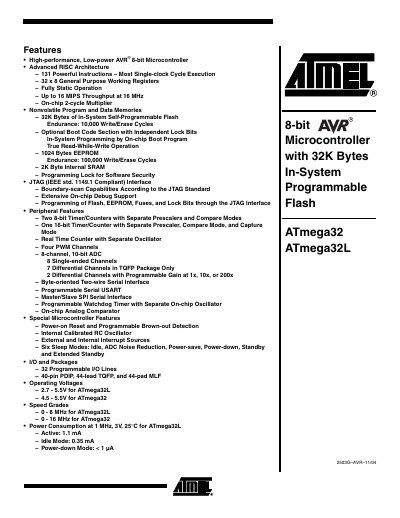
The ATmega32 and ATmega32L are low‑power 8‑bit AVR microcontrollers featuring up to 32 KB of in‑system programmable Flash, 1 KB EEPROM, 2 KB SRAM, and a rich peripheral set including timers, PWM, ADC, USART, SPI and JTAG. They operate from 2.7 V to 5.5 V (ATmega32L) or 4.5 V to 5.5 V (ATmega32) and can deliver up to 16 MIPS at 16 MHz.
This manual covers the device’s pin‑out diagrams, detailed pin descriptions, core architecture, register set, status register, programming options, and example code. It also includes electrical specifications, power‑saving modes, and reference information for developers writing firmware for these microcontrollers.
| Flash Memory | 32 KB |
|---|---|
| EEPROM | 1 KB |
| SRAM | 2 KB |
| Operating Voltage (ATmega32L) | 2.7 V – 5.5 V |
| Operating Voltage (ATmega32) | 4.5 V – 5.5 V |
| Maximum Throughput | 16 MIPS at 16 MHz |
| ADC | 8‑channel, 10‑bit |
| Programmable I/O Lines | 32 |
The device includes 32 KB of in‑system self‑programmable Flash memory.
ATmega32L operates from 2.7 V to 5.5 V, while ATmega32 operates from 4.5 V to 5.5 V.
It provides 32 programmable I/O lines.
The ATmega32 can achieve up to 16 MIPS at 16 MHz.