
This document describes a high-performance, low-power AVR® 8-bit microcontroller with advanced RISC architecture, high-endurance non-volatile memory segments, and various peripheral features.
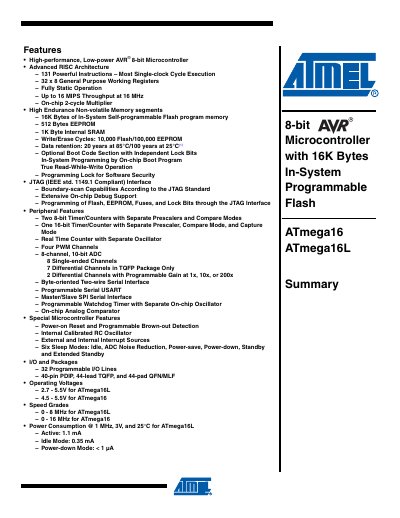
The ATmega16 is a low‑power CMOS 8‑bit microcontroller based on the AVR enhanced RISC architecture. It offers up to 16 Kbytes of In‑System Self‑Programmable Flash, 512 bytes EEPROM, and 1 Kbyte SRAM, with 32 programmable I/O lines and a rich peripheral set including timers, ADC, USART, SPI and JTAG.
The device operates from 2.7 V to 5.5 V (ATmega16L) or 4.5 V to 5.5 V (ATmega16) and supports speed grades up to 8 MHz (L) or 16 MHz. Power consumption is as low as 1.1 mA active, 0.35 mA idle, and less than 1 pA in power‑down mode.
| Flash program memory | 16 KB |
|---|---|
| EEPROM | 512 bytes |
| SRAM | 1 KB |
| Operating voltage (ATmega16L) | 2.7 V – 5.5 V |
| Operating voltage (ATmega16) | 4.5 V – 5.5 V |
| Speed grade (ATmega16L) | 0 – 8 MHz |
| Speed grade (ATmega16) | 0 – 16 MHz |
| Active power consumption (1 MHz, 3 V) | 1.1 mA |
| Idle mode power consumption | 0.35 mA |
| Power‑down mode current | < 1 pA |
| Programmable I/O lines | 32 |
It provides 16 KB of In‑System Self‑Programmable Flash program memory.
ATmega16L operates from 2.7 V to 5.5 V, while ATmega16 operates from 4.5 V to 5.5 V.
The device consumes about 0.35 mA in idle mode.
The ATmega16 offers 32 programmable I/O lines.