
The MAX3237E is a 3-V to 5.5-V multichannel RS-232 1-MBit/s line driver/receiver. The device meets or exceeds the requirements of TIA/EIA-232-F and ITU v.28 standards, and provides ±15 kV – Human-Body Model (HBM), ±8 kV – IEC61000-4-2, Contact Discharge, ±15 kV – IEC61000-4-2, Air-Gap Discharge ESD protection.
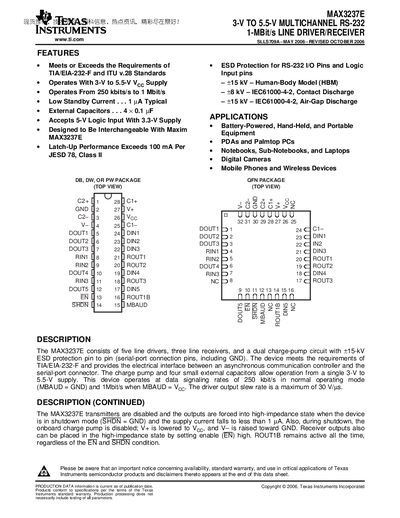
The MAX3237E provides five line drivers and three line receivers with a dual charge‑pump circuit and +15‑kV ESD protection. It converts between 3‑V to 5.5‑V supplies and RS‑232 signal levels, enabling operation from 250 kbit/s up to 1 Mbit/s.
Key features include low standby current, latch‑up performance, and compatibility with a wide range of portable devices such as PDAs, notebooks, digital cameras, and mobile phones. The device is offered in several package options (DBR, PWR, QFN) and is qualified for industrial temperature ranges.
| Supply voltage range | 3 V to 5.5 V |
|---|---|
| Data rate | 250 kbit/s to 1 Mbit/s |
| Line drivers | 5 |
| Line receivers | 3 |
| Shutdown supply current | < 1 µA |
It operates from 3 V to 5.5 V.
The device supports data rates up to 1 Mbit/s.
The MAX3237E contains five line drivers.
In shutdown mode the supply current is less than 1 µA.