
The MAX3237E is a 3-V to 5.5-V multichannel RS-232 1-MBit/s line driver/receiver that meets or exceeds the requirements of TIA/EIA-232-F and ITU v.28 standards. It features ESD protection, low standby current, external capacitors, support for 5-V logic input and 3.3-V supply, and is designed for interchangeability with Maxim equipment.
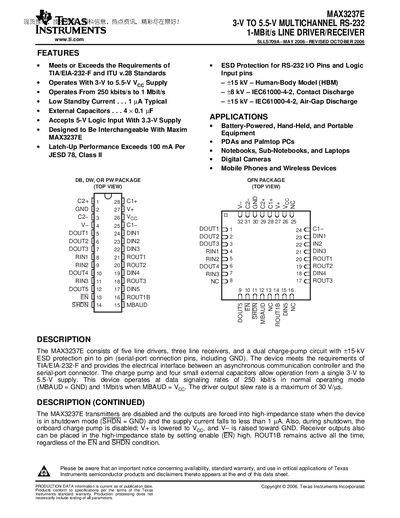
The MAX3237E provides five line drivers and three line receivers in a single chip, enabling RS‑232 communication from a single 3‑V to 5.5‑V supply. It meets TIA/EIA‑232‑F and ITU‑V.28 standards and offers high‑level ESD protection for all serial‑port pins.
The device operates at data rates from 250 kbit/s to 1 Mbit/s, with a typical standby current of 1 µA. Various package options are available, including QFN, DB, DW and PW, and the part is qualified for operation over a wide temperature range (‑40 °C to 85 °C for some variants).
| Data rate | 250 kbit/s to 1 Mbit/s |
|---|---|
| Drivers / Receivers | 5 line drivers, 3 line receivers |
| Standby current (typical) | 1 µA |
| Input voltage range (absolute max) | -0.3 V to 6 V |
The device supports data rates up to 1 Mbit/s (250 kbit/s to 1 Mbit/s).
It contains five line drivers and three line receivers.