
This document introduces the features and characteristics of Toshiba TLP192G optocoupler photorelay, which is suitable for PC card modems, PBX, set-top boxes, and measurement equipment. This product has a high withstand voltage characteristic, making it suitable for hook relays and dial-pulse for modems and facsimiles. Moreover, the TLP192G is used for PCMCIA-compliant card modems because the maximum mounted height of the SOP package is as small as 2.1 mm.
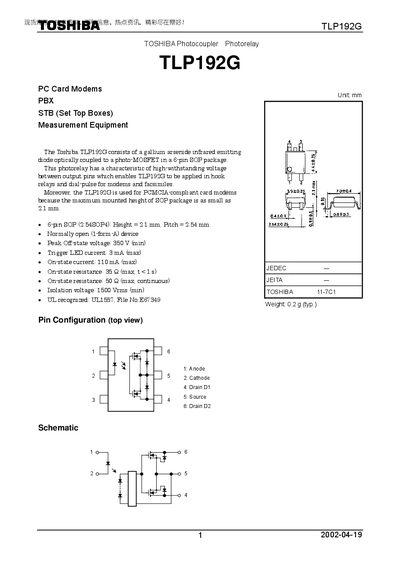
The TLP192G is a gallium arsenide infrared emitting‑diode photorelay optically coupled to a photo‑MOSFET in a 6‑pin SOP package. It is intended for use in PCMCIA‑compliant card modems, PBX, set‑top boxes, measurement equipment and other general electronics applications.
The document lists maximum ratings, recommended operating conditions, electrical and switching characteristics, pin configuration, and safety restrictions. Key parameters include a 350 V off‑state voltage, 110 mA on‑state current, 1500 Vrms isolation voltage, and operation from –20 °C to 65 °C.
| Off‑state output terminal voltage (VOFF) | 350 V (min) |
|---|---|
| On‑state current (Ion) | 110 mA (max) |
| Isolation voltage | 1500 Vrms (min) |
| Trigger LED current | 3 mA (max) |
| Forward voltage (VF) at IF=10 mA | 1.0‑1.3 V |
The device can withstand an off‑state voltage of at least 350 V.
It is rated for a minimum isolation voltage of 1500 Vrms.
The datasheet specifies a supply voltage up to 280 V.
The device is specified to operate from –20 °C to 65 °C.