
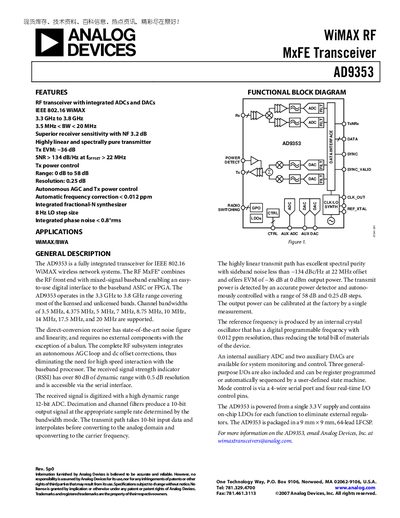
The AD9353 is a fully integrated transceiver for IEEE 802.16 WiMAX systems. It combines the RF front‑end with mixed‑signal baseband, providing a digital interface to a baseband ASIC or FPGA and requiring only a balun as external component.
Key features include a 3.3‑3.8 GHz frequency range, 3.5 MHz < BW < 20 MHz bandwidth, 12‑bit ADC, 10‑bit DAC, autonomous AGC, Tx power control up to 58 dB, 8 Hz LO step size and low phase noise (< 0.8° rms). The device is powered from a single 3.3 V supply and packaged in a 9 mm × 9 mm, 64‑lead LFCSP.
| Frequency range | 3.3 GHz to 3.8 GHz |
|---|---|
| Supported bandwidth | 3.5 MHz < BW < 20 MHz |
| Receiver noise figure | 3.2 dB |
| Tx EVM | ‑36 dB |
| SNR | > 134 dB/Hz at 22 MHz offset |
| Tx power control range | 0 dB to 58 dB |
| Tx power control resolution | 0.25 dB steps |
| LO step size | 8 Hz |
| Phase noise | < 0.8° rms |
| ADC resolution | 12‑bit |
| DAC output resolution | 10‑bit |
| Supply voltage | 3.3 V single supply |
| Package | 9 mm × 9 mm, 64‑lead LFCSP |
The AD9353 operates from 3.3 GHz to 3.8 GHz.
The receiver has a noise figure of 3.2 dB.
It provides autonomous TX power control with a range of 0 dB to 58 dB and 0.25 dB resolution.
The received signal is digitized with a 12‑bit ADC.